USAID DEC
Potentials of cocoa pod husk-based compost on Phytophthora pod rot disease suppression, soil fertility, and Theobroma cacao L. growth
Sign inUNIVERSITY OF MARYLAND
Potentials of cocoa pod husk-based compost on Phytophthora pod rot disease suppression, soil fertility, and Theobroma cacao L. growth
Cocoa black pod disease, caused by Phytophthora megakarya, is a major constraint to cocoa production in Central and West Africa, resulting in high yield losses.
2018 · 9 pages
Sign in to readA free account is required to download.
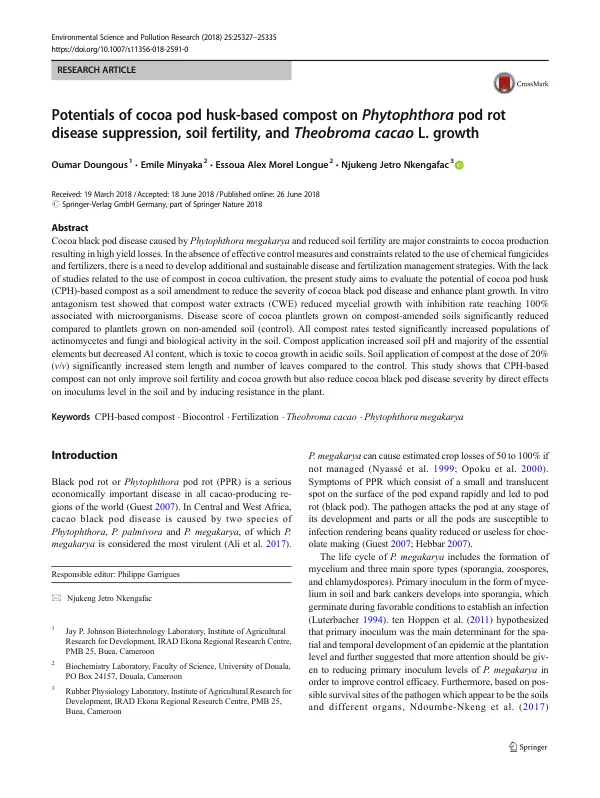
Abstract
The disease is characterized by a small and translucent spot on the surface of the pod that expands rapidly, leading to pod rot. The pathogen attacks the pod at any stage of its development and parts or all the pods are susceptible to infection, rendering beans quality reduced or useless for chocolate making. Phytophthora megakarya has a complex life cycle, including the formation of mycelium and three main spore types. Primary inoculum in the form of mycelium in soil and bark cankers develops into sporangia, which germinate during favorable conditions to establish an infection. The pathogen can survive in soils and infected debris for months to several years, causing root infections and maintaining a reservoir of inoculum that can infect other parts of the plant via water splashing from the soil to the foliage. Current control strategies for Phytophthora pod rot (PPR) include the use of copper-based and systemic fungicides, which are not sustainable due to soil-borne P. megakarya surviving in soils and infected debris for extended periods. Cultural practices such as optimizing shade and aeration through appropriate spacing and pruning to reduce surface wetness are recommended to lower the incidence of the disease. However, these practices are labor-intensive, expensive, and economically viable only if market prices of cocoa are high. Biological control may have potential as a component in integrated pest management strategies for PPR. Composts are important to agriculture and horticulture as they can be added into soil or container media to supply plant nutrients and suppress diseases. Cocoa pod husks (CPHs) are rich in nutrients but large amounts are discarded in piles after beans are harvested. Enriched cocoa pod composts have been shown to improve plant height, dry matter production, and foliar N concentration in cocoa seedlings. The objectives of this study were to assess antagonistic effects of compost water extracts (CWE) on mycelial growth of P. megakarya, evaluate the potentials of CPH-based compost to suppress black pod disease using detached leaf inoculation method, and investigate which changes in soil characteristics following compost application are critical to the control of P. megakarya and growth of T. cacao. The study was carried out at the Institute of Agricultural Research for Development, IRAD Ekona Regional Research Centre, located in Ekona, South West Region of Cameroon. Composting process involved preparing CPH-based compost on-station for a 3-month duration. CPH (1000 kg) with PPR symptoms or not, cocoa dry leaves (10 kg), and Gliricidia sepium green leaves (20 kg) were chopped into pieces and mixed with poultry manure (4 kg) and wood ash (10 kg). Composting materials were then moistened with tap water and alternately layered into a heap. Compost pile was turned twice a week and covered with a black polyethylene. Moisture content and temperature were monitored periodically. Detection of P. megakarya in the mature compost was carried out using PDA (potato dextrose agar) medium in petri dishes. Samples of the mature compost were collected and tested for the presence of P. megakarya. The results showed that the mature compost was pathogen-free, indicating that the composting process was effective in eliminating P. megakarya. The study evaluated the antagonistic effects of CWE on mycelial growth of P. megakarya and found that CWE reduced mycelial growth with an inhibition rate reaching 100% associated with microorganisms. The study also evaluated the potentials of CPH-based compost to suppress black pod disease using detached leaf inoculation method and found that compost application significantly reduced disease severity compared to the control. The study investigated which changes in soil characteristics following compost application are critical to the control of P. megakarya and growth of T. cacao and found that compost application increased soil pH and majority of the essential elements but decreased Al content, which is toxic to cocoa growth in acidic soils.
Related documents