USAID
Pounds of Prevention - A Disaster Risk Reduction Story
Malawi's economy is heavily reliant on agricultural production, making the country vulnerable to droughts and their associated impacts on food security.
2012 · 1 pages
Sign in to readA free account is required to download.
Abstract
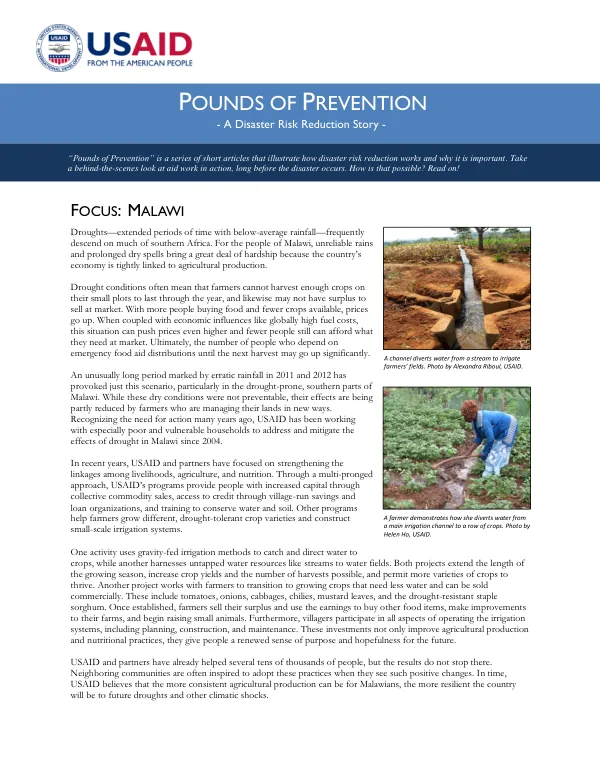
Unreliable rains and prolonged dry spells frequently affect southern Africa, resulting in reduced crop yields and limited market access for farmers. This situation leads to increased food prices, exacerbated by global economic factors such as high fuel costs, ultimately pushing more people to rely on emergency food aid distributions. The effects of drought in Malawi were particularly pronounced in 2011 and 2012, when an unusually long period of erratic rainfall led to widespread crop failures and economic hardship. However, farmers who have adopted new land management practices have been able to mitigate the impacts of drought. Recognizing the need for action, USAID has been working with poor and vulnerable households in Malawi since 2004 to address and mitigate the effects of drought. USAID's programs in Malawi focus on strengthening the linkages among livelihoods, agriculture, and nutrition. A multi-pronged approach provides people with increased capital through collective commodity sales, access to credit through village-run savings and loan organizations, and training to conserve water and soil. Additionally, programs help farmers grow drought-tolerant crop varieties and construct small-scale irrigation systems. These initiatives aim to increase crop yields, extend the growing season, and permit more varieties of crops to thrive. One project uses gravity-fed irrigation methods to catch and direct water to crops, while another harnesses untapped water resources like streams to water fields. These projects have been successful in increasing crop yields and the number of harvests possible, allowing farmers to sell their surplus and use the earnings to improve their farms and livelihoods. Villagers are also involved in all aspects of operating the irrigation systems, including planning, construction, and maintenance. These investments not only improve agricultural production and nutritional practices but also give people a renewed sense of purpose and hopefulness for the future. USAID's efforts have already helped tens of thousands of people in Malawi, and neighboring communities are often inspired to adopt these practices when they see the positive changes. In time, USAID believes that more consistent agricultural production can make Malawians more resilient to future droughts and other climatic shocks.
Related documents