POWER AFRICA
Power Africa Generation Projects
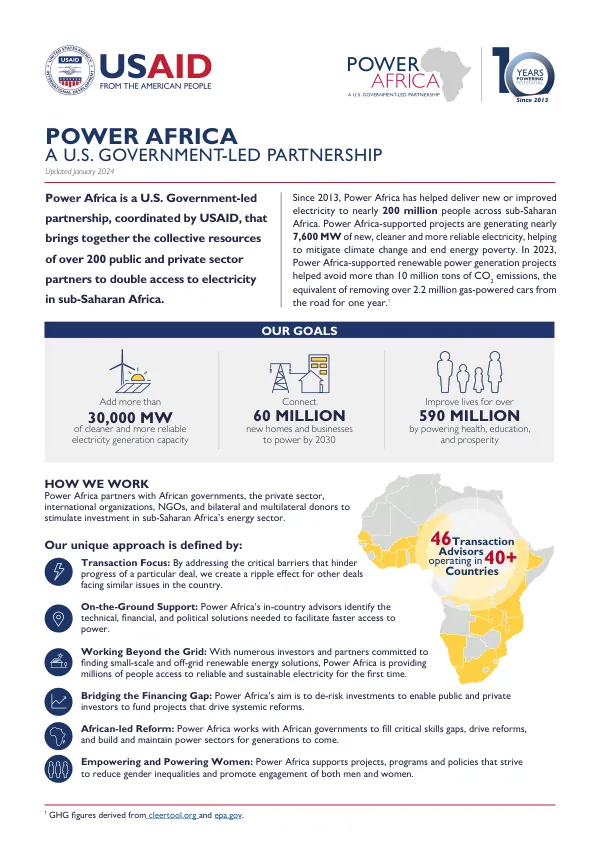
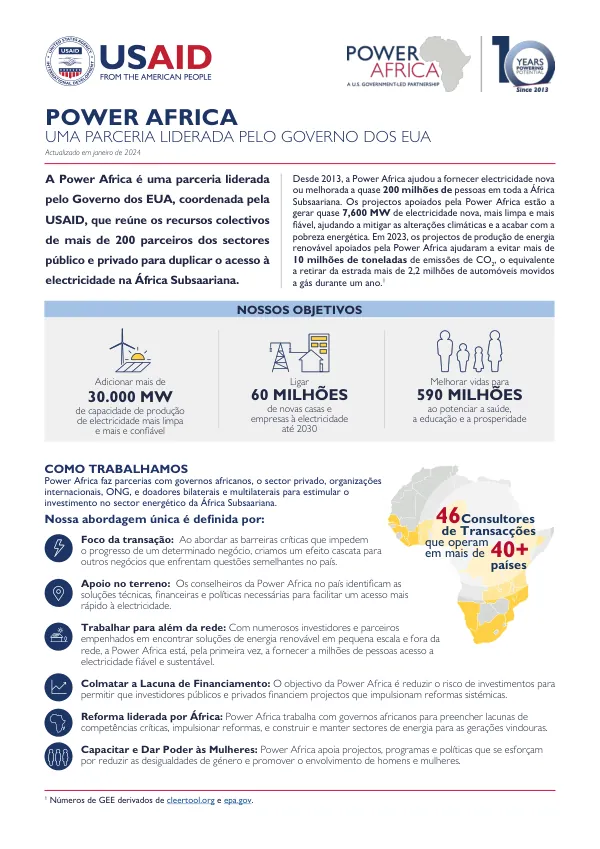
Power Africa is a U.S.
2020 · 2 pages
Sign in to readA free account is required to download.
Abstract
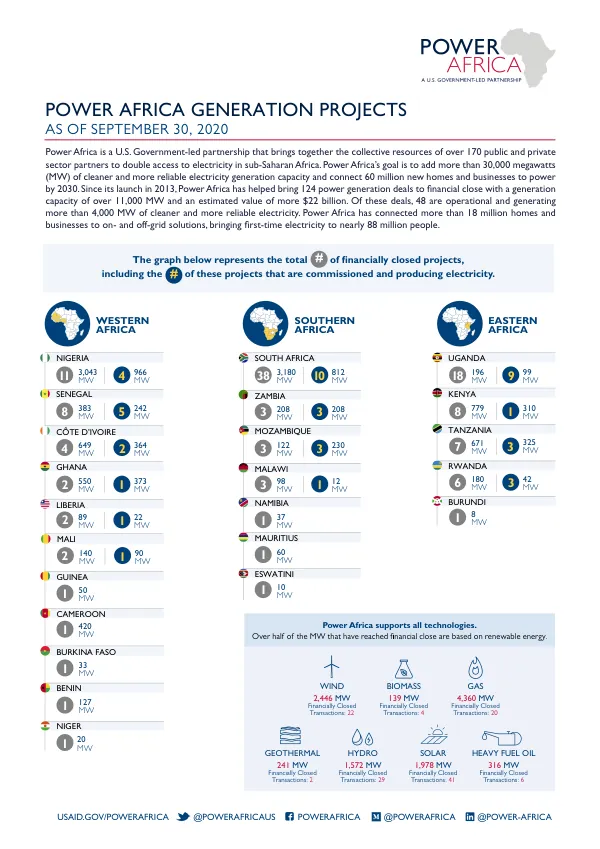
Government-led partnership that brings together the collective resources of over 170 public and private sector partners to double access to electricity in sub-Saharan Africa. The initiative aims to add more than 30,000 megawatts (MW) of cleaner and more reliable electricity generation capacity and connect 60 million new homes and businesses to power by 2030. Since its launch in 2013, Power Africa has helped bring 124 power generation deals to financial close with a generation capacity of over 11,000 MW and an estimated value of more than $22 billion. Of these deals, 48 are operational and generating more than 4,000 MW of cleaner and more reliable electricity. Power Africa has connected more than 18 million homes and businesses to on- and off-grid solutions, bringing first-time electricity to nearly 88 million people. The majority of the MW that have reached financial close are based on renewable energy, with over half of the total capacity coming from solar, wind, and hydroelectric power. The largest share of the capacity comes from natural gas, with 4,360 MW of projects financially closed. Other technologies supported by Power Africa include biomass, geothermal, and heavy fuel oil. The initiative has supported projects in various countries across sub-Saharan Africa, including Nigeria, South Africa, Uganda, Senegal, Namibia, Tanzania, Côte d'Ivoire, Zambia, Rwanda, Ghana, Mozambique, Kenya, Liberia, Malawi, Burundi, Guinea, Mauritius, Cameroon, Eswatini, Mali, Niger, Burkina Faso, and Benin. The projects vary in size, with the largest being in Nigeria, where 3,043 MW of capacity has been financially closed. Some notable projects supported by Power Africa include the Azura-Edo natural gas project in Nigeria, the Kinyerezi I natural gas project in Tanzania, and the Kpone Independent Power Plant in Ghana. The initiative has also supported several solar projects, including the Hardap Solar project in Namibia, the Centrale solaire photovoltaïque de Zagtouli project in Burkina Faso, and the Gigawatt Global Agahozo-Shalom Youth Village Solar Project in Rwanda. Overall, Power Africa has made significant progress in increasing access to electricity in sub-Saharan Africa, with a focus on renewable energy and sustainable development. The initiative continues to support projects that promote energy access, economic growth, and poverty reduction in the region.