GEORGETOWN UNIVERSITY'S INSTITUTE FOR REPRODUCTIVE HEALTH
Powerful Partnerships: Engaging Faith Leaders in Norms-Shifting Interventions
Social norms have a significant influence on behaviors, shaping what individuals consider acceptable and desirable.
2021 · 7 pages
Sign in to readA free account is required to download.
Abstract
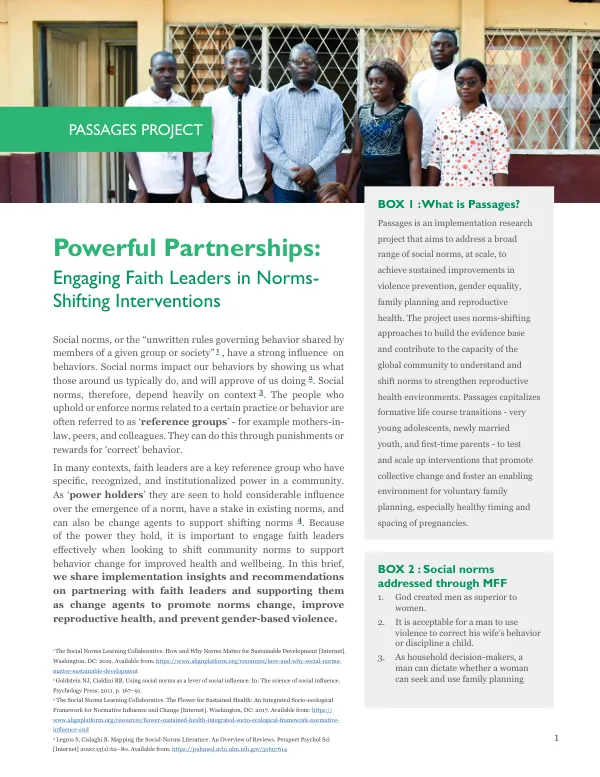
These unwritten rules are context-dependent and often enforced by reference groups, such as mothers-in-law, peers, and colleagues. Faith leaders, in particular, hold considerable influence over the emergence of a norm, have a stake in existing norms, and can serve as change agents to support shifting norms. Faith leaders are often seen as powerful influencers in communities, with a strong impact on beliefs and practices. In the Democratic Republic of Congo, for example, 75% of male and female respondents considered religion to be very important in their lives and attended a church service weekly. Faith leaders can shape and sustain equal or unequal gender norms through references to Biblical scriptures and guidance on marriage and family life. The Masculinité, Famille et Foi (MFF) project aimed to increase voluntary family planning use, reduce intimate partner violence, and improve gender equality and male engagement in household work and childcare amongst newly-married couples and first-time parents. The project was implemented in 17 Protestant churches in Kinshasa, Democratic Republic of Congo, in partnership with the Eglise du Christ au Congo (ECC) from 2015-2020. ECC is an umbrella network that unites a large number of diverse Protestant denominations with a reach of 300,000+ parishes and 25 million members nationally. MFF focused on young couples at transition moments in their lives, namely, entering marriage and becoming parents. Faith leaders were engaged to create a supportive environment for young couples and to effect a change in norms across the congregation. Congregation members were selected and trained to be Gender Champions, who facilitated community dialogues for young couples over a period of 8 weeks. Using scripture-based reflections, the groups discussed unequal gender norms and the use of power as related to IPV, and the need to make family planning choices as a couple. To mitigate the risk of reinforcing patriarchal power, male and female faith leaders were selected from each congregation to participate in the project. They attended facilitated scriptural reflection workshops, where they examined how they used their power in the home, the community, and in their leadership. Faith leaders from throughout the church hierarchy attended reflective workshops to gain their support and approval for the community-level activities, but also to encourage this normative shift within the faith institution towards gender equity, greater shared-decision making, and collaborative leadership. Faith leaders played a key role in modelling change, sharing MFF values in their sermons and pre-marriage counselling, selecting congregation members to be trained as Gender Champions, and supporting the community dialogues and the family planning presentations. Faith leaders with national, provincial, and local congregational roles took part in separate facilitated, reflective workshops designed to affect attitude change amongst faith leaders and produce behavior changes in their personal lives.