USAID DEC
Policy Implementation Assessment of USAID's Building Resilience to Recurrent Crisis: Policy and Program Guidance
Sign inECO CONSULTING GROUP
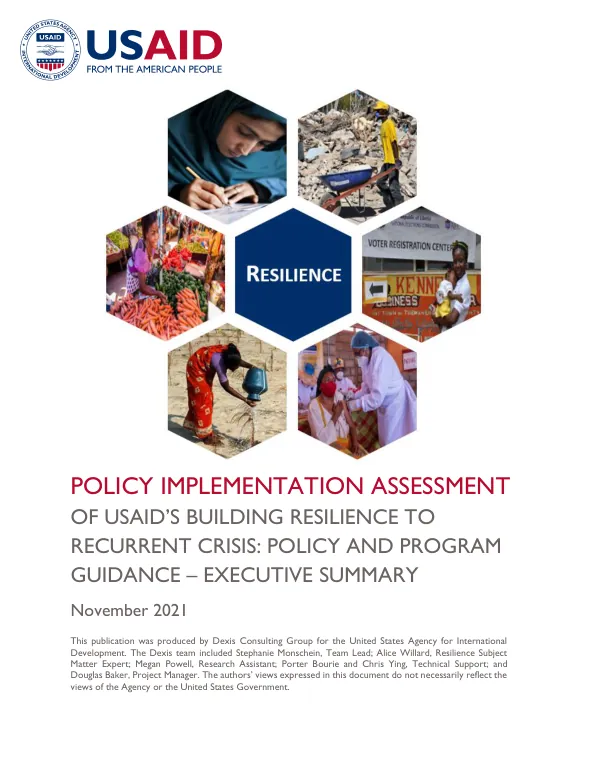
Policy Implementation Assessment of USAID's Building Resilience to Recurrent Crisis: Policy and Program Guidance
The Building Resilience to Recurrent Crisis: Policy and Program Guidance was published by the United States Agency for International Development (USAID) in 2012.
2021 · 8 pages
Sign in to readA free account is required to download.
Abstract
The policy defines resilience in the context of USAID and aims to build resilience by increasing the capacity of systems and people to reduce risk and better withstand shocks and stressors. The policy includes a set of principles to apply across resilience programming and an operational agenda directed toward increasing effective, multi-sectoral collaboration across humanitarian assistance (HA) and development assistance (DA) actors. The operational agenda applies in a set of Resilience Focus Countries (RFCs), which receive 'resilience funding' through a variety of mechanisms. The policy implementation assessment (PIA) aims to examine the extent to which the Agency has achieved the objectives laid out in this policy through shifts in processes and programs. The PIA was conducted between December 2020 and November 2021 and focused on six assessment questions examining policy implementation in RFCs, the evidence base for progress toward policy goals, mainstreaming of resilience across the Agency, supportive institutional structures, and recommendations for the Policy's revision. The PIA found that USAID's operational agenda was robustly applied by two regional structures, called Joint Planning Cells (JPCs). The JPCs emphasized cross-team collaboration among HA and DA teams and had similar goals to a Regional Development Cooperation Strategy (RDCS) team but operated outside of the Program Cycle and focused exclusively on resilience. The HoA JPC was an effective structure for implementing the Resilience Policy's operational agenda and its legacy continues through the Horn of Resilience Network (HoRN). The Sahel JPC was also an effective structure, bolstered by the creation of the Sahel Regional Office (SRO) and drawing on lessons in strategic planning and mutually-informed project design from the HoA. USAID has applied aspects of the Operational Agenda throughout the Program Cycle and Humanitarian Assistance in RFCs, but experience varies across countries, between new and old RFCs, and among the four components of the operational agenda. Document analysis showed stronger policy alignment at the strategic planning level and less alignment moving down the Program Cycle into project and activity design. Even in RFCs, where the leadership support is strong and ties to the Resilience Policy's operational agenda are explicit, there are challenges to implementation, including uneven collaboration and disjointed timelines for procurements between DA and HA. The PIA also found that USAID has been a thought leader in building an evidence base and generating guidance on resilience measurement, although much of this is still being executed and data collection on high-level impact is ongoing. Evidence building has occurred primarily through baseline, midline, endline, and recurrent monitoring surveys for impact evaluations. The resilience-focused Program Cycle Documents (PCDs) selected for analysis scored a 2.5 out of 4 on average for policy alignment, indicating coordination with HA stakeholders and a resilience focus within the Results Framework, but not full coordination or evidence of Sequencing, Layering, and Integrating (SLI).