USAID
PQM+ Quarterly Report: Program Year 2, Quarter 2
The Promoting the Quality of Medicines Plus (PQM+) program is a five-year cooperative agreement between the U.S.
2021 · 88 pages
Sign in to readA free account is required to download.
Abstract
Agency for International Development (USAID) and the U.S. Pharmacopeial Convention (USP) to sustainably strengthen medical product quality assurance systems in low- and middle-income countries (LMICs). PQM+ works to improve medical product quality through cross-sectoral and systems strengthening approaches and the application of international quality assurance standards across the pharmaceutical system. PQM+ focuses on improving access to quality-assured essential medicines for HIV/AIDS, tuberculosis (TB), malaria, neglected tropical diseases (NTDs), and other infectious diseases, as well as for reproductive, maternal, newborn, and child health (RMNCH). The program achieves this by sharing scientific expertise and providing technical support and leadership to create resilient local health systems. The PQM+ program is pleased to present this quarterly report for Program Year 2, Quarter 2 (January 1 – March 31, 2021). This report summarizes the activities undertaken during this period and presents cumulative progress by objective and source of funding (USAID country Missions and USAID/Washington). All activities align with at least one of PQM+'s five program objectives, which are detailed in the Results Framework. PQM+ has supported the development or revision of at least 20 policies, laws, and regulations to improve governance for medical product quality assurance systems. Regulatory systems play a critical role in any country, primarily concerned with enabling patient access to quality-assured, safe, and effective medical products, as well as preventing proliferation of poor-quality, unsafe products. When appropriately implemented, regulations ensure public health benefits and the safety of patients, healthcare workers, and the community. The program has also made significant progress in implementing risk-based inspection methodologies, developing the Medicines Risk-based Surveillance (MedRS) tool, and establishing a model to estimate the economic and health impact of substandard or falsified (SF) medicines. Additionally, PQM+ has provided technical assistance to countries to strengthen their pharmaceutical systems, including the development of common standards for pharmaceutical information management and the implementation of a pharmaceutical systems strengthening course. In the Africa Region, PQM+ has supported the development of a risk-based inspection methodology framework and the implementation of a pharmaceutical systems strengthening course. In the Asia Region, the program has provided technical assistance to countries to strengthen their pharmaceutical systems and improve access to quality-assured essential medicines. In the Europe and Eurasia Region, PQM+ has supported the development of a model to estimate the economic and health impact of SF medicines. The program has also made significant progress in addressing the COVID-19 pandemic, providing technical assistance to countries to strengthen their pharmaceutical systems and improve access to quality-assured essential medicines. In Bangladesh, Pakistan, and Serbia, PQM+ has supported the development of risk-based inspection methodologies and the implementation of a pharmaceutical systems strengthening course. Overall, PQM+ has made significant progress in achieving its program objectives, improving governance for medical product quality assurance systems, and strengthening pharmaceutical systems in LMICs. The program continues to work towards its goal of creating resilient local health systems that ensure access to quality-assured essential medicines for HIV/AIDS, TB, malaria, NTDs, and other infectious diseases, as well as for RMNCH.
Related documents
Documents in this collection
 2021
2021USAID DEC
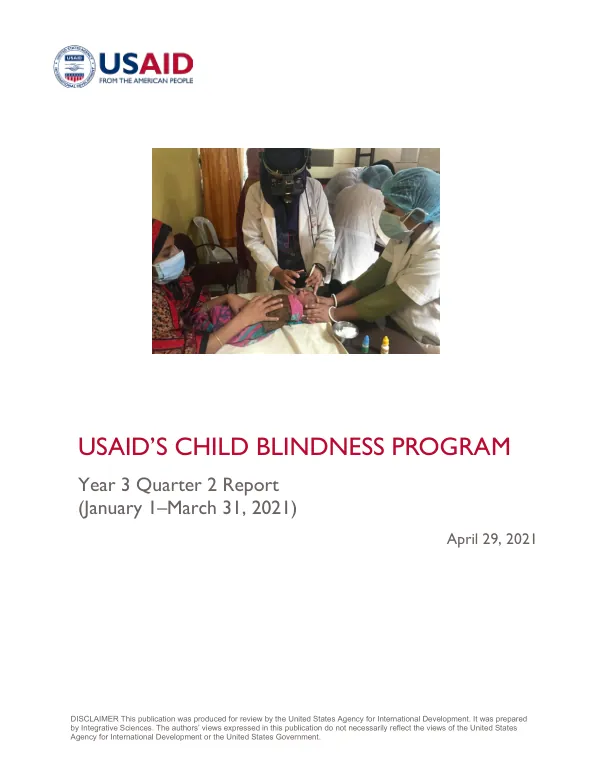
USAID’s Child Blindness Program YEAR 3 QUARTER 2 Report
Open record 2021
2021USAID DEC