UNIVERSITY OF FLORIDA
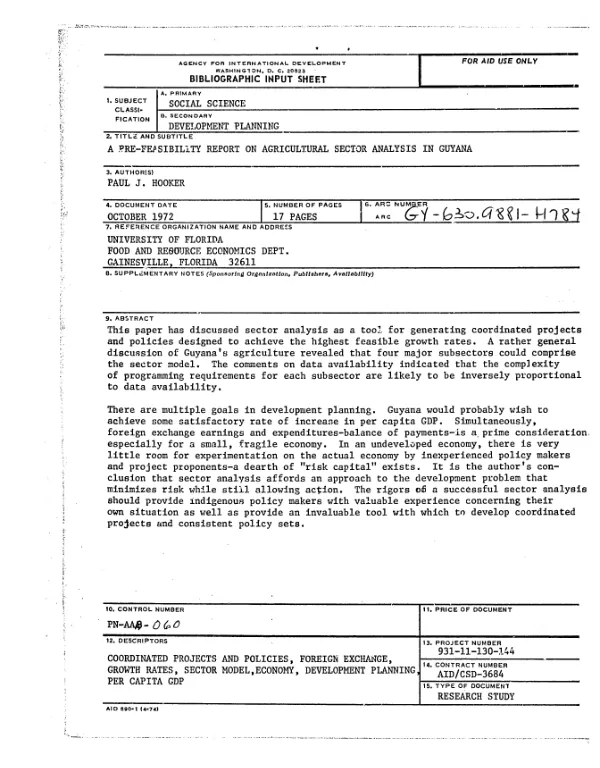
Pre-feasibility report on agricultural sector analysis in Guyana
This paper has discussed sector analysis as a tool for generating coordinated projects and policies designed to achieve the highest feasible growth rates.
Hooker, P. J. · 1970
Sign in to readA free account is required to download.
Abstract
A rather general discussion of Guyana"s agriculture revealed that four major subsectors could comprise the sector model. The comments on data availability indicated that the complexity of programming requirements for each subsector are likely to be inversely proportional to data availability. There are multiple goals in development planning. Guyana would probably wish to achieve some satisfactory rate of increase per capita GDP. Simultaneously, foreign exchange earnings and expenditures -- balance of payments -- is a prime consideration, especially for a small, fragile economy. In an undeveloped economy, there is very little room for experimentation on the actual economy by inexperienced policy makers and project proponents -- a dearth of "risk capital" exists. It is the author"s conclusion that sector analysis affords an approach to the development problem that minimizes risk while still allowing action. The rigors of a successful sector analysis should provide indigenous policy makers with valuable experience concerning their own situation as well as provide an invaluable tool with which to develop coordinated projects and consistent policy sets.
Connected topics
Related documents