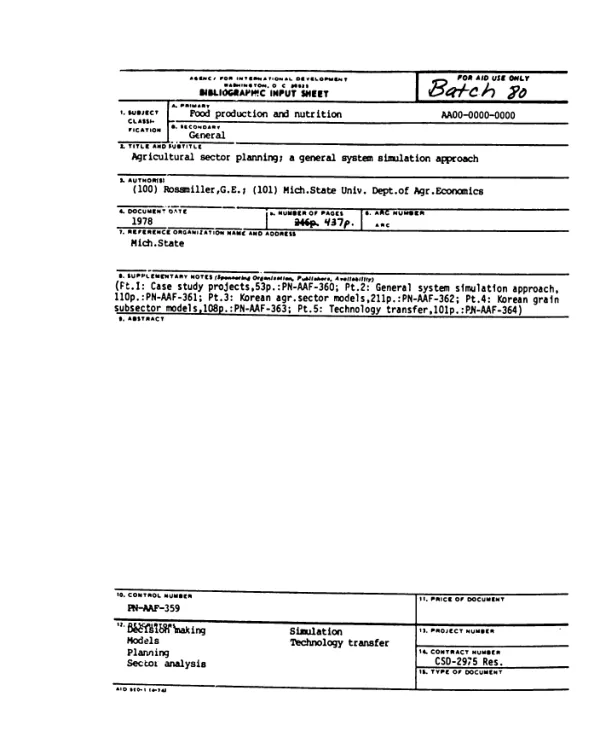
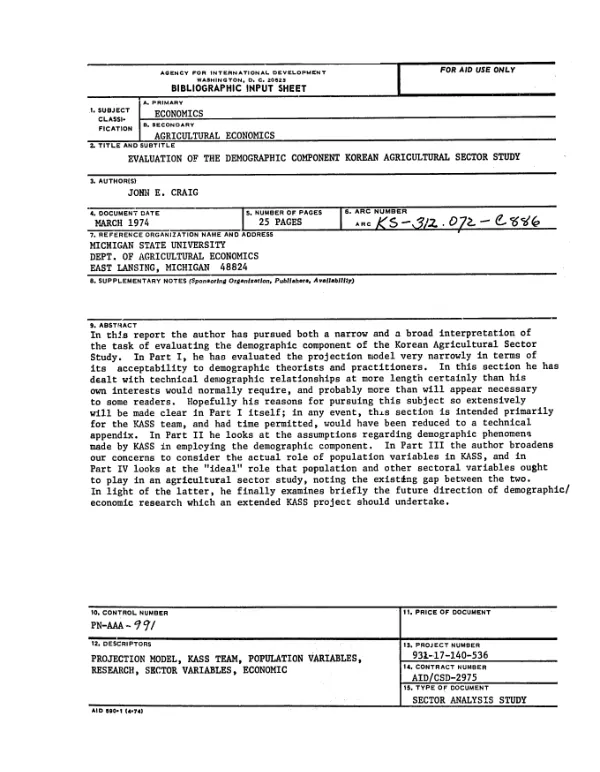
MICHIGAN STATE UNIVERSITY. DEPT. OF AGRICULTURAL ECONOMICS
AGRICULTURAL SECTOR PLANNING; PART IV : THE KOREAN GRAIN SUBSECTOR MODELS
Part IV of the Agricultural Sector Planning Report conveys a general understanding of the overall concept of the Grain Management Program (GMP) model, including the felt need for and objectives of the model"s design; and what the model can do to assist researchers and decision makers in Korea.
GIBSON, F. J.; ROSSMILLER, GEORGE E. +1 more · 1970
Sign in to readA free account is required to download.
Abstract
Equations are found in the discussion to aid in the description of key concepts and relationships. Food grains are by far the most important agricultural commodity group in Korea; therefore, more depth and detail are needed in studying problems related to these commodities than can be provided from the Korean Agricultural Sector Model alone. The GMP model focuses solely on the Korean food grain system and when used to supplement the broader KASM can provide insight into and analysis of food grain problems not otherwise possible. The model had two objectives: (1) to approximate the real world food grain system in Korea as it responds to various grain management programs, policies, and decisions and (2) to design control systems for the model that will enable its use as an online grain management tool by government administrators in directing existing grain management programs to achieve prescribed objectives. The model is fully computerized and uses FORTRAN. It produces summary data at prespecified intervals that can be output in table format for the convenience of the model user.
Connected topics