USAID. BUR. FOR SCIENCE AND TECHNOLOGY. OFC. OF AGRICULTURE
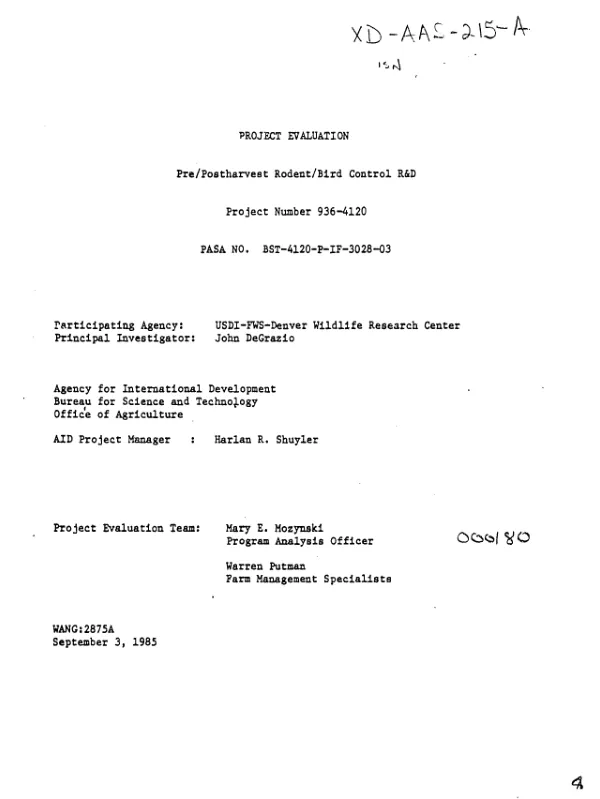
Pre/postharvest rodent/bird control R&D
Evaluates project to reduce food losses in LDC"s by developing improved vertebrate pest management (VPM) systems.
Jackson, R. I.; Shuyler, H. R. · 1985
Sign in to readA free account is required to download.
Abstract
PES covers the period 1/1/83-8/31/85 and summarizes an attached special evaluation (XD-AAS-215-A) based on document review and interviews with AID/W and Denver Wildlife Research Center (DWRC) officials. The project is achieving its purpose. Close to $600 million in food losses - including a $14 million reduction in rice losses from rats in the Philippines, a $1 million annual savings by reducing rodent damage to coconuts in Colombia, and substantial reductions in bird damage to experimental crops in Sudan and East Africa - have been prevented through the use of DWRC-developed VPM methods. Thousands of farmers, extensionists, technicians, biologists, veterinarians, administrators, and others in East and West Africa, Bangladesh, Haiti, and the Philippines have received informal and/or formal training at DWRC, U.S. universities, or in-country. Eight participants - against a target of two - have completed or are enrolled in advanced degree programs. In 1983-84, DWRC provided 614 person-days of TA in 25 countries (more than twice the amount planned), assessing vertebrate pest problems, reviewing research programs, presenting seminars, conducting applied research, and strengthening indigenous institutions. Also, DWRC is contributing some $200,000 annually to the project in free use of facilities, equipment, and scientists (similar to the contributions made in cooperative agreements with U.S. universities). The project has taught that VPM is a specialized, complex, and expanding field which A.I.D. should support, preferably by a long-term, centrally funded project. Other lessons are: (1) the importance of carefully determining a project"s goal; (2) the value of a multidisciplinary approach to research; (3) the extent to which networking in VPM can be established when a participating agency follows up on routine inquiries; and (4) the advisability of beginning VPM assistance in a small way so as not to overwhelm LDC agencies. The main action decision is to prepare a new Project Paper with quantifiable outputs and a narrower goal, namely, to increase LDC food supplies by reducing losses to vertebrate pests in both pre- and postharvest situations; this latter goal can be and in fact is being achieved.
Related documents