USAID. BUR. FOR SCIENCE AND TECHNOLOGY. OFC. OF AGRICULTURE
Postharvest grain systems research and development project
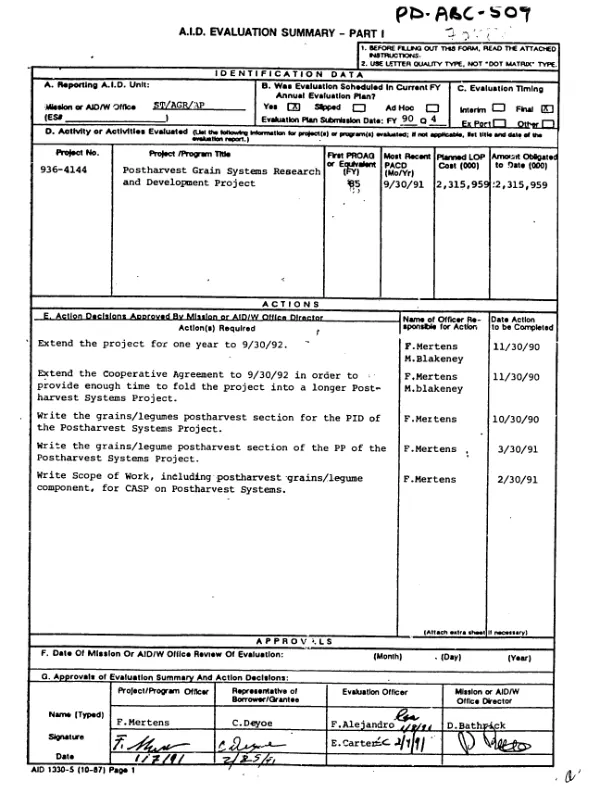
Summarizes final evaluation (XD-ABC-509-A) of a project to help reduce postharvest cereal grain and legume losses in developing countries through research, technology transfer, training, and networking.
1991
Sign in to readA free account is required to download.
Abstract
External evaluation covered the period FY85-7/90; the PACD is 2/15/91. Despite a 30% reduction in A.I.D. funding, the contractor, Kansas State University"s Food and Feed Grains Institute (FFGI), made significant progress in 5 areas cited in a 1988 evaluation. Specifically: (1) publication and distribution of research output increased 95%; (2) a newsletter was initiated to maintain contact with former students and other postharvest professionals; (3) a new research facility was opened in 1989; (4) an attempt was made to initiate cooperation with international research centers (but no interest was indicated); and (5) there was some collaboration with other S&T Bureau projects, although no well- defined mechanism for cooperation was developed. In addition, FFGI has been very active in identifying additional sources of funding. From 1986 to 1990, FFGI has managed to achieve a leverage position of $2.80 to every $1.00 allocated by A.I.D. FFGI has an experienced and dedicated research and administrative staff. Researchers have worked overtime on the project, and most of the research was pertinent to the project goals. TA in policy analysis related to grain storage and marketing increased and technical documents were developed to address this important area. Technology transfer is facilitated by the Postharvest Documentation Service, a computerized data retrieval system, which includes a Documents by Mail system. FFGI"s short course on grain storage and marketing for developing country students is very successful and has an international reputation. FFGI also participated in in-country training, though this was limited by dependence on USAID Missions. Membership in the Group for Assistance on Systems Related to Grain after Harvest is FFGI"s most important networking activity, although FFGI also has connections with several developing country and university research centers. FFGI has also been very active in identifying non-A.I.D. funding sources. Although FFGI seems to have sufficient professional and administrative staff to meet the requirements of the Cooperative Agreement, at peak work load time researchers devote considerable time to other activities. Also, the uncertainty of new S&T funding has made the non-tenured staff apprehensive about their future. A new Cooperative Agreement is recommended, since any further loss of staff would disrupt specific work assignments.
Related documents
Documents in this collection
 1990
1990USAID DEC
Evaluation of the postharvest grain systems research and development project, Food and Feed Grains Institute, Kansas State University
Open record 1990
1990USAID DEC