VIRGINIA POLYTECHNIC INSTITUTE AND STATE UNIVERSITY
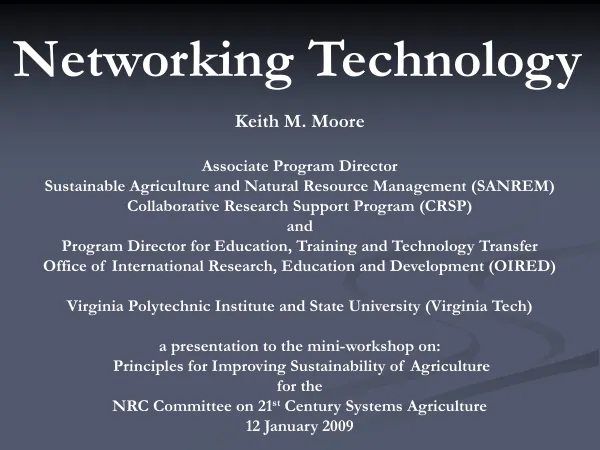
Principles for Improving Sustainability of Agriculture
Technical change in agriculture is a complex process that involves the development of capacities for on-going adaptation.
2009 · 19 pages
Sign in to readA free account is required to download.
Abstract
This process is not solely a matter of information transfer resulting in the adoption of innovations, but rather a dynamic interplay between people, technologies, and socio-material relationships. The concept of learning is crucial in this context, as it enables farmers and other stakeholders to adapt to changing ecological and market conditions. The steps of technology transfer involve the rationalization of socio-material relationships in the agro-ecology, where people and technologies are interconnected in ways that reproduce some types of knowledge and behavioral practices and not others. This process is influenced by the characteristics of knowledge networks, which operate well under conditions where technological change is a matter of component replacement, shared knowledge systems extend from conception to execution, and ecological and market conditions are stable and relatively homogeneous. However, in reality, ecological and market conditions are often unstable and heterogeneous, requiring farmers and other stakeholders to innovate management techniques adapted to local conditions. This process of social learning for adaptive management involves negotiation, resistance, and accommodation among different stakeholders, including producers, input producers, consumers, research institutions, regulators, and civil society organizations. Successful negotiation requires building trust across boundaries, which can be achieved by providing credible, salient, and legitimate scientific information that takes into account the needs and values of different stakeholders. This information should be respectful of stakeholder divergent values and beliefs, and should be communicated in a way that is accessible and understandable to all parties involved. The IPM actor network, which includes producers, input producers, consumers, research institutions, regulators, supermarkets, wholesalers, processors, shippers, government, civil society, and credit systems, plays a crucial role in facilitating the exchange of information and resources necessary for adaptive management. The production ecology, which encompasses the complex relationships between these actors, is critical in determining the success of technology transfer and innovation in agriculture. Ultimately, the development of capacities for on-going adaptation and the ability to innovate management techniques adapted to local conditions are essential for improving the sustainability of agriculture. This requires a deep understanding of the complex relationships between people, technologies, and socio-material relationships, as well as the ability to communicate scientific information in a way that is credible, salient, and legitimate to all stakeholders involved.