USAID DEC
Private Sector Recommendations for Renewable Energy Auctions in Thailand and Malaysia
Sign inBANK FOR WEST AFRICAN DEVELOPMENT
Private Sector Recommendations for Renewable Energy Auctions in Thailand and Malaysia
The International Renewable Energy Agency (IRENA) reported in 2017 that electricity from renewable energy (RE) was poised to be consistently cheaper than from fossil fuels.
2018 · 4 pages
Sign in to readA free account is required to download.
Abstract
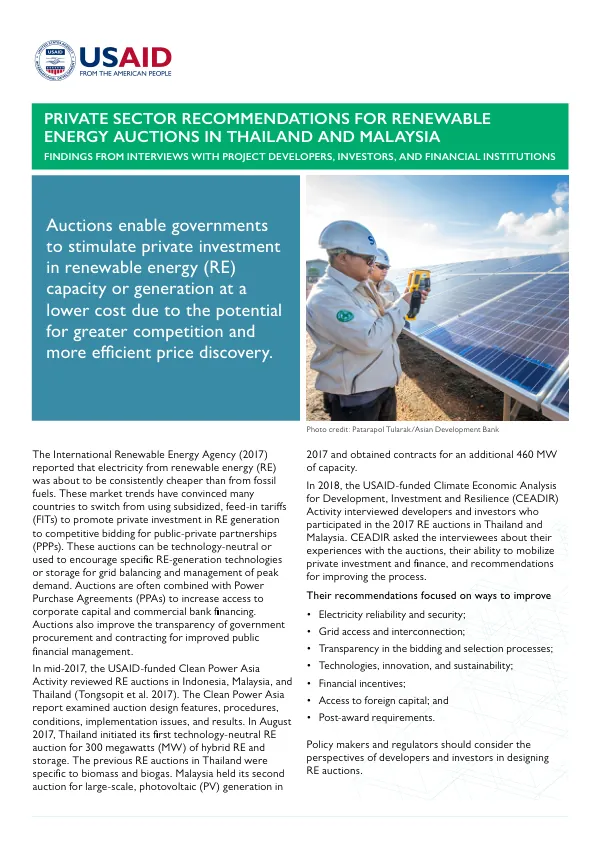
This market trend has led many countries to switch from using subsidized, feed-in tariffs (FITs) to promote private investment in RE generation to competitive bidding for public-private partnerships (PPPs). RE auctions can be technology-neutral or used to encourage specific RE-generation technologies or storage for grid balancing and management of peak demand. Auctions are often combined with Power Purchase Agreements (PPAs) to increase access to corporate capital and commercial bank financing. RE auctions also improve the transparency of government procurement and contracting for improved public financial management. In 2017, the USAID-funded Clean Power Asia Activity reviewed RE auctions in Indonesia, Malaysia, and Thailand. The Clean Power Asia report examined auction design features, procedures, conditions, implementation issues, and results. Thailand initiated its first technology-neutral RE auction for 300 megawatts (MW) of hybrid RE and storage in August 2017. The previous RE auctions in Thailand were specific to biomass and biogas. Malaysia held its second auction for large-scale, photovoltaic (PV) generation in 2017 and obtained contracts for an additional 460 MW of capacity. The USAID-funded Climate Economic Analysis for Development, Investment and Resilience (CEADIR) Activity interviewed developers and investors who participated in the 2017 RE auctions in Thailand and Malaysia. CEADIR asked the interviewees about their experiences with the auctions, their ability to mobilize private investment and finance, and recommendations for improving the process. The interviewees' recommendations focused on ways to improve electricity reliability and security, grid access and interconnection, transparency in the bidding and selection processes, technologies, innovation, and sustainability, financial incentives, access to foreign capital, and post-award requirements. Thailand held its first two RE auctions in 2016, both of which were technology-specific. The first auction awarded contracts for 10 MW of biogas generation, and the second for 36 MW of biomass power. In August 2017, Thailand conducted a third RE auction under a new Small Power Producers (SPP) Hybrid Program, which was the first in Asia to require RE producers to commit to supplying firm power and allowed bids based on either a single RE technology or a combination of two or more technologies for more consistent feed-in to the grid. The auction was for a total of 300 MW of capacity from 10 to 50 MW power plants. The Energy Regulatory Commission (ERC) of Thailand selected 17 bids in December 2017, with 14 of these bids being for biomass power from bagasse and three for hybrids combining PV and energy storage. The awarded prices ranged from $0.06 to $0.11/kWh, and the projects are required to be operational by December 2021. CEADIR interviewed representatives of seven companies that participated in the third auction, including four that received contracts. The interviewees agreed that the SPP Hybrid Program auction regulations were acceptable and largely clear but raised concerns about the upfront costs of engineering, bid bonds, and the low pricing that may have limited the number of bids. The interviewees recommended that the government broaden requirements for firm power delivery, improve grid access and interconnection, consider technology-specific RE auctions, and consider alternatives to auctions. They also suggested that the government give additional points to auction bids for investments in underserved areas. Malaysia held its first RE auction for large-scale solar (LSS) power generation in 2016, which was heavily oversubscribed, and the Malaysia Energy Commission (EC) decided to award more capacity than originally planned. The EC held its second solar auction (LSS2) in early 2017, which was also heavily oversubscribed, and selected bids for a total of 563 MW in December 2017.