USAID. MISSION TO PHILIPPINES
Privatization project
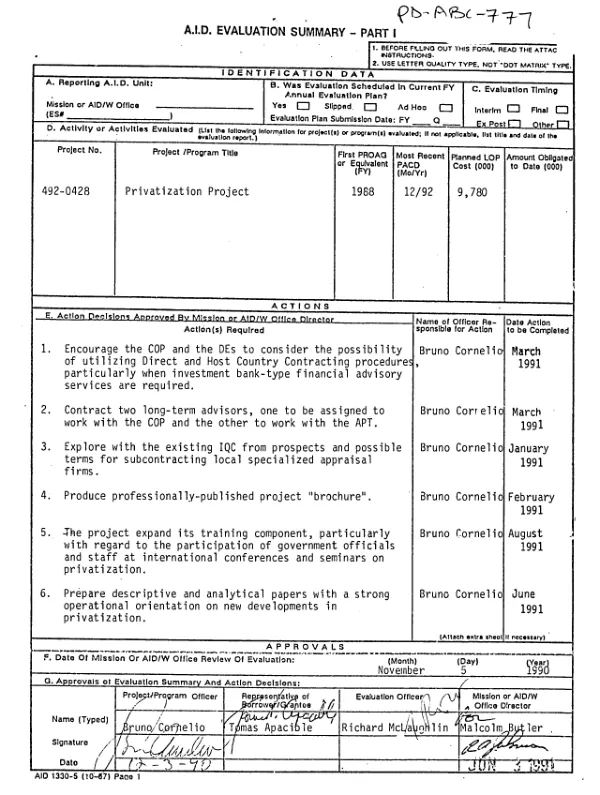
Summarizes attached interim evaluation (XD-ABG-759-A) of a project to reinforce the privatization policy of the Government of the Philippines (GOP) by supporting the divestiture of selected government owned or controlled corporations (GOCCs) and Transferred Assets (TAs), thereby helping to improve the country"s budget situation.
1993
Sign in to readA free account is required to download.
Abstract
Coordinated by the Private Enterprise Support Office (PESO) of USAID, the primary responsibility of overseeing the project has been with the Philippine Department of Finance (DOF). The evaluation covers the period 6/88-6/92. The adequacy and relevance of project"s design are confirmed by the project performance indices as of June 1992. Level of earmarks stand at 88.3% of the total, with the equivalent of $3.95 million worth of assistance earmarked against an obligated grant amount of $4.5 million. Grant funds for training have been fully utilized while level of earmarks for TA, equipment, and special studies stand at 95%, 87%, and 85%, respectively. Eighty GOCCS and TAs representing over 11 disposition entities (DEs) have sought and obtained funding for a wide range of technical assistance for policy reviews, asset appraisal/valuation, privatization design, and implementation or advisory services. The assistance provided through the project has helped in the full or partial disposition of 10 accounts. Thirty-two accounts are ready for bidding/rebidding while 38 more are in the process of being further assessed and reviewed for possible privatization. Revenues generated through the disposition of GOCCs and TAs assisted by the project have contributed well over 22% of the total proceeds of privatization accruing to the GOP in the last six years. Even though the project has been successful in achieving its subordinate but essential objective of assisting the beneficiary accounts readied for sale, there is need for providing further strategic guidance towards meeting bottom-line project goals -- actually selling GOCCs and TAs. Also, DOF officials have expressed keen interest in exploring the possibility of extending the coverage of the existing project or evolving an equivalent TA program to apply to retained GOCCs or other government services/activities. The following lessons are noted: (1) The project"s technical assistance has served as a catalyst in accelerating interest or intensifying pressure on the custodial or operating managers of the assets to privatize, where the political will or motivation was absent or the skills to prepare the asset for privatization were not available. (2) As in any effort, the ultimate measure of success is the bottom line. In a privatization program, the bottom line is how much has been sold, in monetary terms and in terms of numbers of entities; there is no other substitute for this measure of success. Studies are good but they must lead to privatization, not simply be archived. Privatization goals must clearly state that the objective is actual privatization, rather than the production of privatization studies. (3) Finally, in implementing a privatization program, there is need to pace the pipeline in such a way that the rate of sales of GOCCs and TAs is constant. (Author abstract, modified)
Related documents