USAID DEC
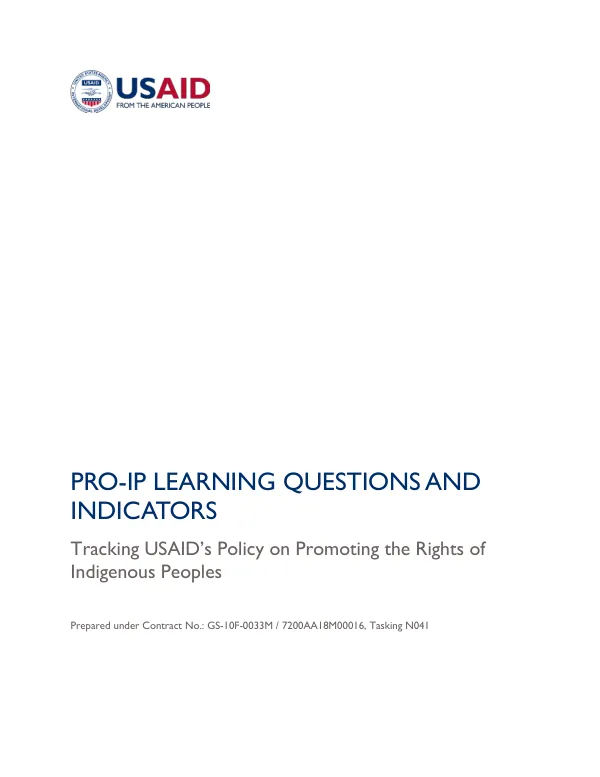
PRO-IP LEARNING QUESTIONS AND INDICATORS: Tracking USAID’s Policy on Promoting the Rights of Indigenous Peoples
Sign inNORC AT THE UNIVERSITY OF CHICAGO
PRO-IP LEARNING QUESTIONS AND INDICATORS: Tracking USAID’s Policy on Promoting the Rights of Indigenous Peoples
USAID's Policy on Promoting the Rights of Indigenous Peoples (PRO-IP) was launched in March 2020 to guide development practitioners in strengthening the design and management of programs that affect Indigenous Peoples.
2023 · 48 pages
Sign in to readA free account is required to download.
Abstract
The policy aims to promote thoughtful and direct engagement of Indigenous Peoples in the design, implementation, and monitoring of projects to ensure the communities benefit and that those benefits are in line with the communities' self-determined development objectives. The PRO-IP contains four objectives: (1) Strengthen engagement with Indigenous Peoples to safeguard against harm and support their development priorities and self-reliance, (2) Increase the integration of Indigenous Peoples' concerns across all sectors of USAID's portfolio of investments and promote cross-sectoral development approaches, (3) Empower Indigenous Peoples and their representative organizations to advocate for, and exercise, their rights and practice self-determined development, and (4) Foster an enabling environment for Indigenous Peoples to advocate for, and exercise, their rights. The policy also contains five operating principles: (1) Identify Indigenous Peoples, (2) Analyze Indigenous Peoples' Opportunities and Challenges, (3) Engage Indigenous Peoples, (4) Safeguard Indigenous Peoples' Rights and Well-Being, and (5) Establish Partnerships with Indigenous Peoples. As part of an activity to build an internal knowledge base and analysis framework on how USAID's operating units are including Indigenous Peoples in development activities in accordance with PRO-IP, NORC at the University of Chicago worked with the Inclusive Development Hub and Indigenous Peoples' organizations to prepare learning questions related to the PRO-IP objectives and principles. The learning questions are designed to address critical knowledge gaps, test assumptions or hypotheses, and support informed decision-making. The questions cover topics such as effective methods of engagement, Indigenous Peoples' metrics of development, sectors that have been effective in integrating Indigenous Peoples' concerns, enabling conditions for Indigenous Peoples to exercise their rights, and common areas in which Indigenous Peoples' self-determined priorities differ from USAID's or host country government's development priorities. The PRO-IP learning questions and indicators are intended to support the development of a learning agenda that includes associated learning/research activities to address or answer each question. The indicators are designed to track implementation of the PRO-IP objectives and principles, and to provide a framework for monitoring and evaluation of USAID's efforts to promote the rights of Indigenous Peoples. The indicators include metrics such as the number of activities or projects designed through co-creation with Indigenous Peoples, the percentage of USG-assisted Indigenous Peoples' organizations with improved performance, and the number of laws, policies, or procedures proposed, adopted, or implemented with USG support that protect Indigenous Peoples' rights. The indicators are intended to provide a comprehensive picture of USAID's progress in promoting the rights of Indigenous Peoples and to inform decision-making and programming. The PRO-IP learning questions and indicators are a critical component of USAID's efforts to promote the rights of Indigenous Peoples and to ensure that development programs are designed and implemented in a way that respects and supports the rights and self-determination of Indigenous Peoples.