USAID DEC
Problems and prospects of multi- and bilateral assistance for agricultural development
Sign inUNIVERSITY OF WISCONSIN AT MADISON
Problems and prospects of multi- and bilateral assistance for agricultural development
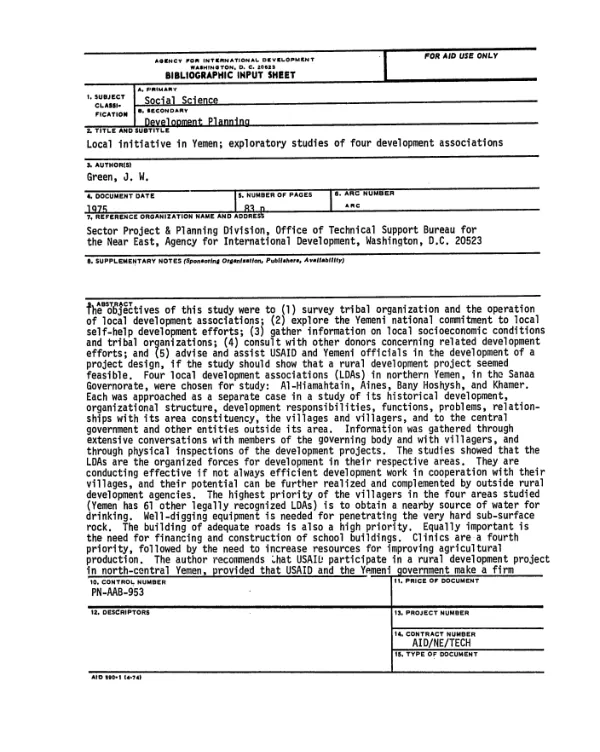
In many countries there is considerable economic growth, but paradoxically, little development.
Dorner, Peter · 1970
Sign in to readA free account is required to download.
Abstract
The reduction of mass poverty, unemployment, and inequality must be included in our conception of development. In most countries there are two sub-sectors of agriculture, large farms and small ones. Without land reforms and related institutional changes, the polarization of economic opportunities increases, and small farmers are displaced as tenants. However, land distribution by itself will not solve all problems. Special programs are needed to provide credit, farm inputs and outputs, health and education, and other services for the small farmer. This is where international assistance agencies for agriculture can function. First, such agencies can help a government achieve its goal of restructuring its economic system for wider participation. Second, every precaution should be taken to insure that their efforts are not actually working counter to the need to improve income distribution, and elevate the conditions of life of the people. Third, there should be better communication and coordination among the multi- and bilateral assistance agencies in any given country.
Connected topics