USAID. MISSION TO EGYPT
Production credit
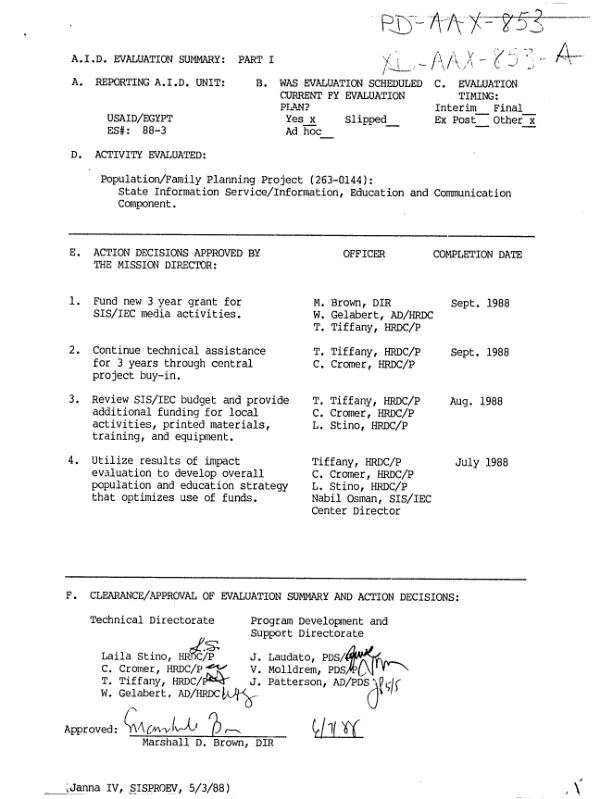
Evaluates project to finance the foreign exchange (FX) costs of raw materials and intermediate and capital goods imported by the Egyptian private sector.
Cowles, David; Suma, James · 1985
Sign in to readA free account is required to download.
Abstract
PES covers the period 8/82-12/85 and is based on an unattached special evaluation. The project has been very successful in financing FX costs: its 288 transactions, valued at $54 million, have covered an extensive list of raw materials and capital equipment for the plastics, poultry, construction, and textiles industries; 68% of these transactions have been for end-users, and the vast majority have been appropriate to Egypt"s development needs. Effective project interest rates, estimated at 22-28 percent, are positive given Egypt"s 20 percent inflation rate. The project"s credit market objectives, however, have not been achieved. Project interest rates are tied to the Central Bank of Egypt"s interest rate structure, which sets minimum rates for short-term trade lending above maximum rates for longer-term industrial credit; as a result, banks have focused on short-term lending. Moreover, the project"s Maintenance of Value (MOV) provision (originally intended to ensure that importers would pay a realistic price for FX), along with an increasingly subsidized FX rate, have encouraged private enterprises to use the project more as a foreign exchange window than as a source of term credit. (Some FX subsidization is justified, however, to offset U.S. source and origin requirements, which add 20-30% to import costs.) In addition, planned training has not been implemented, due to institutional problems and delays in developing a training plan, and the Private Sector Steering Committee, which was to provide guidance on macroeconomic issues, has not met. Action decisions are to: (1) remove the MOV provision; (2) implement training; (3) convene the Steering Committee; and (4) in follow-on credit projects: initiate policy dialogue to encourage an interest rate structure favorable to longer-term production lending; develop a flexible mechanism for adjusting effective FX rates, while taking into account U.S. source and origin requirements; use local currency generations to improve the credit market or to support exports; and consider providing term credit in both FX and local currency, especially for firms in exports or with comparative advantage. (Near East Abstract, modified)
Related documents