USAID DEC
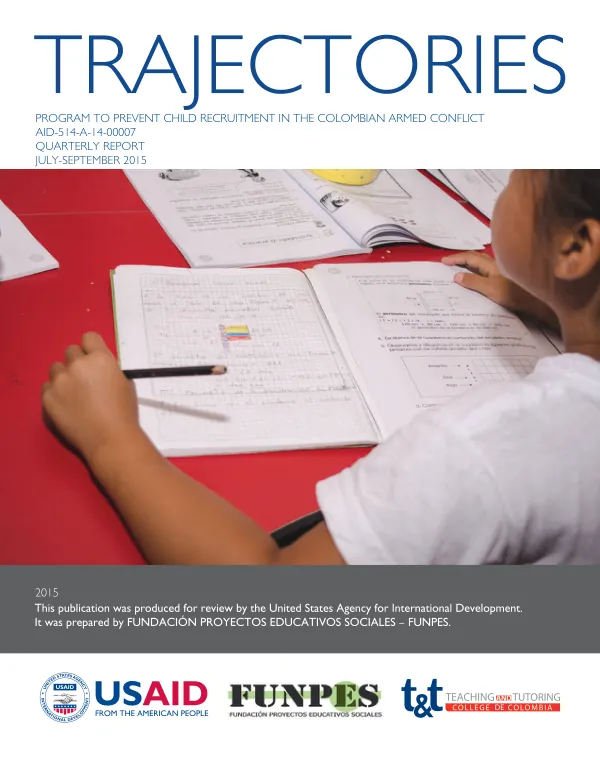
Program to Prevent Child Recruitment in the Colombian Armed Conflict
The Colombian armed conflict has resulted in the pervasive recruitment of boys, girls, and adolescents (BGAs) by Illegal Armed Organizations (IAOs) and other Criminal Bands (BACRIM).
2015 · 105 pages
Sign in to readA free account is required to download.
Abstract
The Trajectories program aims to restore BGAs' rights by mitigating the effects of the conflict on them and promoting a long-lasting peace. The program's main goal is to achieve that children, youths, and their families develop behaviors, skills, and capacities within safe and friendly environments to become less vulnerable to recruitment and participation in the armed conflict. The program is based on the Theory of Change and focuses on the People to People approach. Five main changes have been identified as necessary to accomplish the main goal of the program: school inclusion activities, welfare and psycho-social attention, social, sporting, and cultural schools (SSCS), community and institutional networks and support, and sensitizing the IAOs. The program is implemented in four Colombian Departments of intense armed confrontation: Caquetá, Putumayo, Nariño, and Meta. During the July-September 2015 quarter, the program focused on the implementation of activities in the five components. Key achievements included the updating of the Work Plan, M&E Plan, and Communication Strategy due to the program's extension. The program also developed educational activities with BGAs in transitory classrooms, implemented the Peace Project in each of the four regions, and strengthened alliances with local authorities and private entities. The program has made significant progress in its first year, with over 500 children and youths from four of the most vulnerable regions in Colombia now developing academic and social skills. Additionally, over 500 families have participated in educational workshops and recreational activities, and over 900 BGAs are actively participating in SSCS. The program has also strengthened over 40 alliances with persons and public and private entities to improve attention to the BGAs and their families. The Colombian armed conflict has multiple causes, mainly due to socio-economic inequalities affecting large segments of the population. The violent armed expression has permeated the dynamics of institutions and people's behavior for over three generations. The program's extension until December 31, 2015, will allow for the consolidation of transformative processes and the collection of key information to prove the Theory of Change. The program's Theory of Change is based on the idea that by addressing the root causes of the conflict and promoting a culture of peace, the BGAs and their families will develop behaviors, skills, and capacities that will make them less vulnerable to recruitment and participation in the armed conflict. The program's five components are designed to address these root causes and promote a culture of peace. The program's implementation has been successful, with significant progress made in the first year. However, the program's extension will allow for further consolidation of transformative processes and the collection of key information to prove the Theory of Change. The program's success will depend on the continued support of local authorities, private entities, and the community. The program's geographic focus is on the four Colombian Departments of intense armed confrontation: Caquetá, Putumayo, Nariño, and Meta. The program's timeframes are from August 4, 2014, to August 3, 2015, with an extension until December 31, 2015. The program's recommendations include the continued support of local authorities, private entities, and the community, as well as the strengthening of alliances and the implementation of the program's five components.