USAID
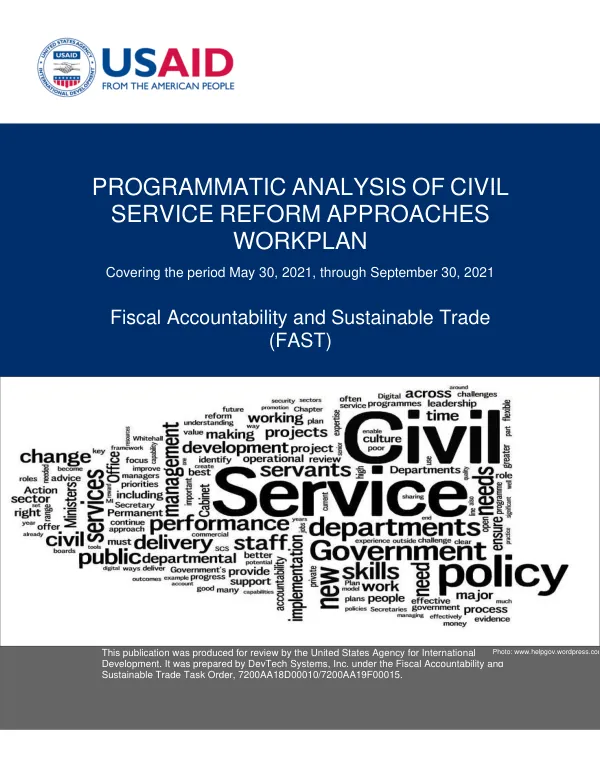
Programmatic Analysis of Civil Service Reform Approaches, Workplan
The Fiscal Accountability and Sustainable Trade (FAST) program supports rapid, sustainable, and equitable economic growth in USAID-assisted countries by enabling USAID to bring a systems approach to addressing public financial management, trade capacity building, macroeconomic planning, and other economic governance issues.
2021 · 9 pages
Sign in to readA free account is required to download.
Abstract
The program aims to improve host-country capacity to mobilize revenue and provide public services, policy environment for investment that generates more employment and inclusive growth, and host-country ability to recover from, prevent, and/or mitigate the impact of conflict, disasters, or fiscal crises. The "Programmatic Analysis of Civil Service Reform Approaches" task under FAST draws on real-world economic and governance experiences of countries to inform USAID on effective approaches to improve public sector performance, accountability, and cost-effective management. The analysis will provide USAID with a set of practical options for its staff to consider in assisting host countries in improving their public sector as an element of promoting sustainable and equitable economic growth. The study will focus on civil service reform to maximize the efficiency and accountability of government service delivery. It will draw on real-world examples, highlighting the political constraints under which reforms are taken, and literature to identify the best practices to address issues such as the appropriate size of government, organizational structures and systems needed to incentivize service delivery, and conditions under which private sector participation can raise the efficiency of service delivery. The research and analysis will be divided into three major themes: good governance and civil service reform, building a capable and resilient state, and civil service reform in challenging circumstances. The first theme will focus on the importance of good governance, anti-corruption efforts, and promoting an environment conducive to investment, growth, and poverty reduction. It will draw on econometric studies published by the International Monetary Fund and World Bank and identify policies considered best practices of civil service reform. The second theme will focus on building a capable and resilient state by identifying steps that can be taken by governments to strengthen the capacity for efficient and effective service delivery, reducing administrative costs, and improving public sector and performance management. The analysis will cover various topics, including public-employment management, pay structures, and technological adaptation, as well as institutional and economic factors that may affect reform in different contexts. The third theme will focus on civil service reform in challenging circumstances, such as conflict, disasters, or fiscal crises. It will identify the best practices to address these challenges and provide recommendations for governments to ensure resilience and efficient service delivery in the face of such shocks. The research will be conducted by a team of experts, including Andrew Wolfe, Elizabeth Kariuki, and Audra Killian, who will draw on a range of sources, including literature reviews, case studies, and stakeholder analysis. The research will be divided into several subsections, which will be developed as part of the research paper outline to be delivered by June 17 for USAID's review and input. The study aims to provide USAID with a set of practical options for its staff to consider in assisting host countries in improving their public sector as an element of promoting sustainable and equitable economic growth. The analysis will focus on the importance of good governance, the need to build a capable and resilient state, and the challenges of implementing civil service reform in challenging circumstances.