USAID DEC
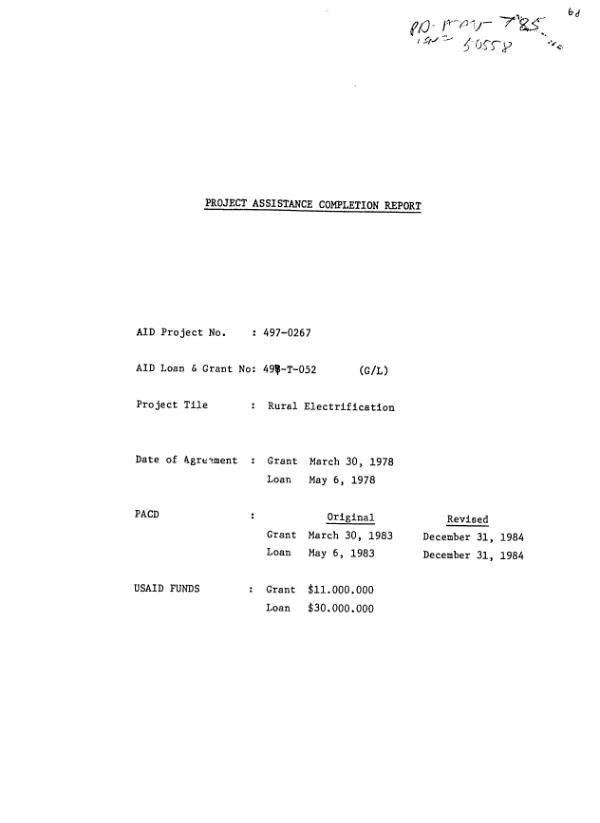
Project assistance completion report : AID project no. 497-0267, AID loan and grant no. 497-T-052, AID project title - rural electrification
Sign inUSAID. MISSION TO INDONESIA
Project assistance completion report : AID project no. 497-0267, AID loan and grant no. 497-T-052, AID project title - rural electrification
Presents final Mission report on a rural electrification (RE) project (3/78-12/84) in Indonesia.
1987
Sign in to readA free account is required to download.
Abstract
Results were mixed. On the positive side, all 10 targeted rural electrical systems are in operation; more than 948 persons from both the State Power Company (PLN) and from Rural Electrical Cooperatives (REC's) were trained in all aspects of electric systems operations; and all loan-funded materials and equipment were delivered to project sites (although not all have been put to use). To assure the affordability of electric services, both the PLN and the REC's offered low-interest loans to rural households for wiring costs. PLN consumers were also offered loans to cover the up front payment, the connection charge, and a consumer's deposit; these loans were not needed in REC areas, since REC's do not charge for connections. On the negative side, only 2,953 km of the targeted 5,863 km of distribution line were built by the revised PACD of 12/84, and these served only 69,467 consumers in 387 villages, vs. a target of 183,000 consumers in 700 villages. Specifically, PLN built 69% of the targeted distribution lines and reached 45.7% of targeted consumers; corresponding figures for the REC's were 18.9% and 18.7%. The major reasons for the slow achievement of outputs were the lengthy process of procurement through international tender (a process complicated by the fact that A.I.D. funded 119 supply contracts under the project), and the unavailability of local wood poles. After the PACD, the Government of Indonesia (GOI) committed itself to complete the project as originally planned and USAID/I agreed to fund an additional year of TA to monitor the use of AID-funded commodities. By the end of 1986, PLN had reached over 132,000 consumers and the REC's over 25,000. The GOI and USAID/I have now agreed to provide $5.4 million in P.L. 480 Title I proceeds to procure diesel generator sets to enable the three project REC's to serve the original target of 50,000 consumers. Due to the project delays, the social and economic impacts of RE have not yet been significant. However, the provision of electricity has resulted in longer night activity, improved lighting, greater household security, and increased business productivity and incomes. Further, the project - the GOI's first major RE program - has successfully triggered a nationwide RE program, funded mostly from the GOI's own resources. The project taught the importance of: procurement time, especially when using international tender; and (2) avoiding the temptation to show progress by fully staffing the consultant team before they are needed.
Related documents