USAID. MISSION TO PAKISTAN
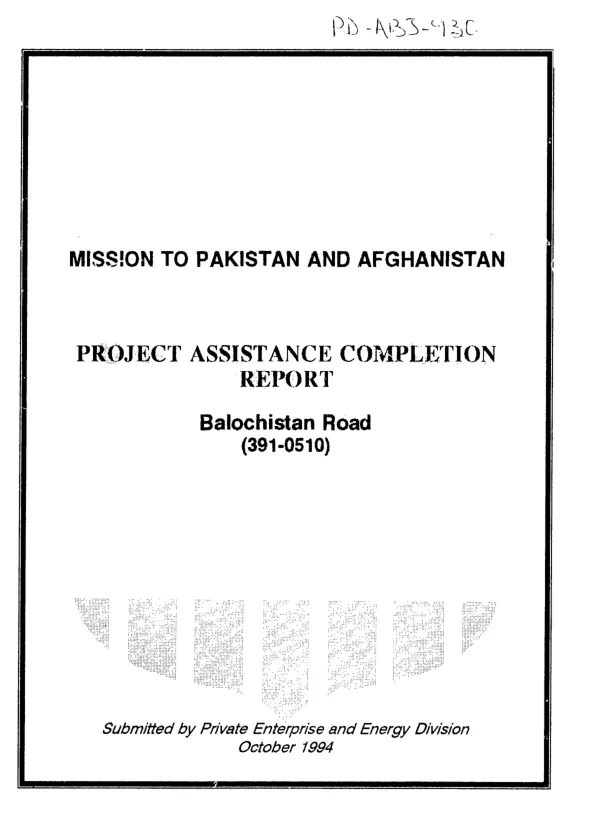
Project assistance completion report : Balochistan road (391-0510)
PACR of a project (8/90-6/94) to link certain remote areas of Khuzdar Division in Balochistan Province, Pakistan, to the national highway network.
1994
Sign in to readA free account is required to download.
Abstract
The project was scaled back significantly from the original plan, which was to link Makran Division in Balochistan Province to the national highway network and to privatize certain road maintenance functions. First, as a result of the Pressler Amendment, the project purpose was revised to completing 56 km of road in Khuzdar Division which had been left unfinished by a defaulting local contractor under the Balochistan Area Development (BALAD) project (3910479). Construction work under the revision commenced in July 1993. However, as a result of USAID/W's mandate that USAID/P rescind $56.2 million, the Mission terminated the project early, and only 44.8% of the work contracted was completed. Due to the early termination, only two of six planned bridges were completed; the third was 50% completed; the fourth was partially completed; and only foundation work was completed on the fifth and sixth. Other accomplishments included: completion of 37 pipe culverts and 6 box-culverts; grading of 5 km of road bed; and rehabilitation of the engineer's base camp at Jhal-Jhao. Several important lessons were learned. (1) When a road project is terminated before it is completed, the portion partially constructed has little or no value and USAID's investment is lost. The incomplete structures stand as a monument to USAID's abandonment of assistance to the area. (2) A construction contract terminated due to contractor default should never be reinstated with the same contractor. NASA, the contractor that defaulted under BALAD, was recontracted with the stipulation that it mobilize an expatriate management team. This was done, but still NASA could not complete even half the project within the contract period. (3) Evaluation of a local firm should be based on that firm's own experience and resources. NASA won approval on the basis of its association with an established Greek contractor which had agreed to provide backup. But when the agreement did not work out, the Greek contractor withdrew within a month. (4) USAID should advance mobilization payments to the local construction contractor; this is the usual practice in Pakistan, where construction financing at reasonable rates is often not available. Lack of such payments places the local contractor in a difficult financial bind. (5) The A/E resident engineer should participate in evaluating construction proposals and choosing contractors. If the engineer is an expatriate, knowledge of English should be required of all construction contractor personnel, at least down to the foreman level. Many onsite problems could have been avoided if these criteria had been followed. (6) In this project, USAID/P placed the onsite materials testing laboratory under the control of the A/E resident engineer rather than the local contractor -- with excellent results. It is recommended that future projects adopt the same practice.