USAID. MISSION TO PAKISTAN
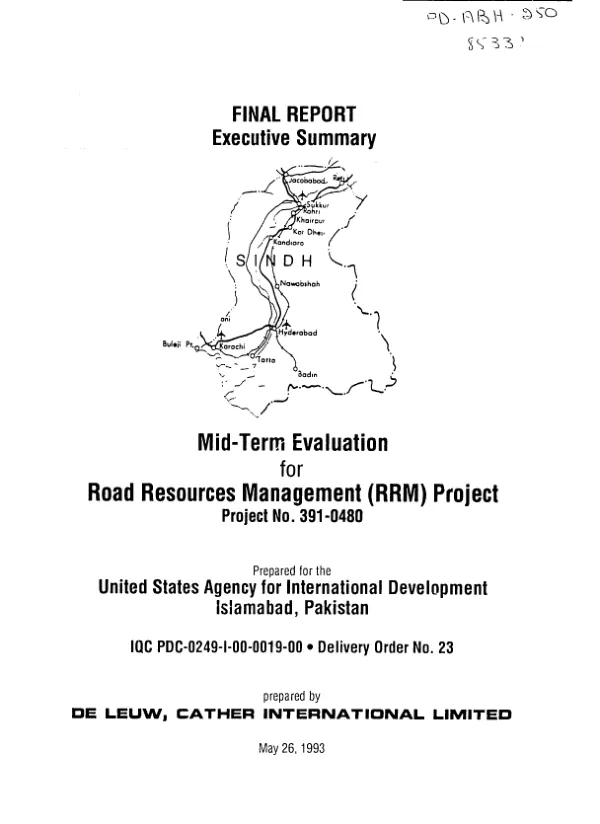
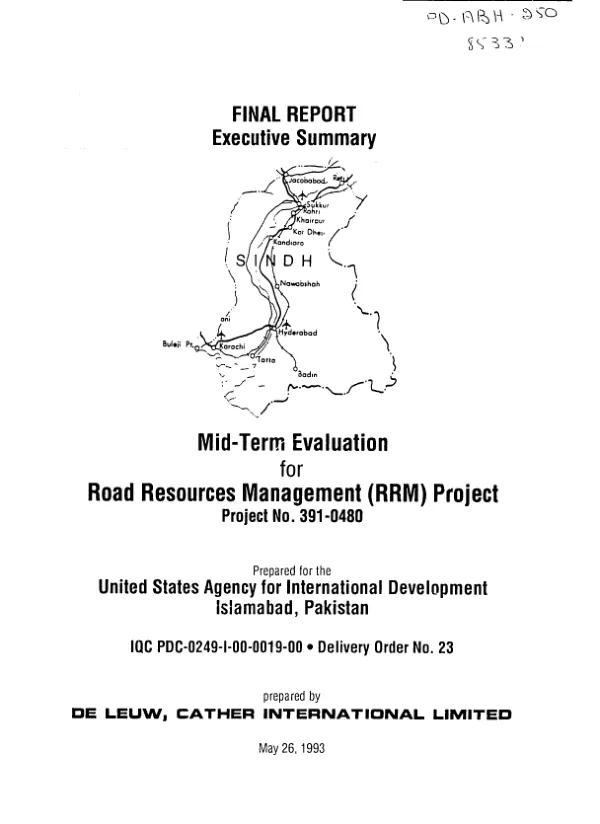
Project assistance completion report : road resources management (391-0480)
PACR of a pilot project (2/87-6/94) to establish a maintainable rural road system in Pakistan's Sindh Province.
1994
Sign in to readA free account is required to download.
Abstract
The project was implemented by the Ministry of Local Government and Rural Development (MLGRD) of the Government of Pakistan (GOP) and the Local Government and Rural Development Department of the Government of Sindh (GOS). Despite ethnic strife and lawlessness in Sindh, the GOS's dissolution of district councils (which to be the main vehicle for ensuring ongoing road maintenance) at the height of the project in anticipation of new council elections, substantial cuts in planned construction due to the Pressler amendment, and finally, termination of the project 6 months early due to growing uncertainty about future funding, significant progress was made. The road rehabilitation/construction component left a substantially improved paved road network (172 km or approximately 80% of the post-Pressler target) which could be economically maintained by the Sindh districts; established procedures for selecting roads for improvement; improved standards for engineering design and preparation of bid documents; and significantly improved construction quality by improving contractor supervision, in the process increasing the number of experienced local contractors. The road maintenance management component established a rural road policy in Sindh which emphasizes maintenance over expansion; improved awareness within district, provincial, and federal agencies about the importance of road maintenance through seminars and workshops; created Road Maintenance Units in district councils; provided training for engineering staff; helped to develop a highly successful maintenance management program at the Asian Institute for Technology (AIT), Thailand, which is still offered by AIT; and instituted mechanisms to allow district councils to contract out road maintenance. The financial management component prepared two pioneering studies of district councils' finances, and disseminated recommendations drawn from the studies. The GOS created a committee to examine the recommendations and propose systems for implementing them. Finally, under the highway policy reform component, the project provided short-term training to senior officials of the National Highway Authority (NHA) and the provincial-level Communications and Works Department and MLGRD in highway planning and policy development, and conducted two important policy studies, one of which led to reorganization of the National Highway Board and creation of the NHA. The following lessons were learned. (1) A rural road program requires a really long-term (up to 20-year) commitment, with short- and medium-term benchmarks to demonstrate progress. (2) Institution building projects are extremely sensitive to changes in donor commitments. In this project, USAID's unilateral termination resulted in loss of interest by the implementing agencies. (3) There is a need for close coordination and open communication between donors involved in road development in Pakistan. (4) GOP/GOS ownership and commitment are critical to the sustainability of an institution building project. (5) The role of GOP/GOS provincial and federal road agencies was neglected in the project design. Also neglected at the design stage was the involvement of local communities in the maintenance of rural roads; it became apparent during implementation that this aspect should be further explored.