USAID DEC
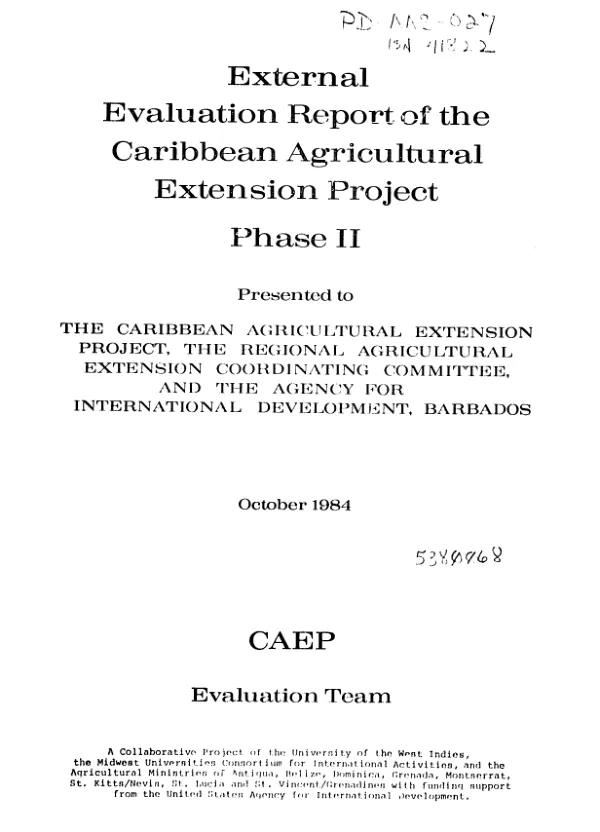
Project assistance completion report [: Caribbean agricultural extension project (CAEP)]
Sign inUSAID. BUR. FOR LATIN AMERICA AND THE CARIBBEAN. REGIONAL DEVELOPMENT OFC.
Project assistance completion report [: Caribbean agricultural extension project (CAEP)]
PACR of a project (1983-1989) to increase the effectiveness of national agriculture extension services in six Eastern Caribbean states and Belize and to strengthen the capacity of the University of the West Indies (UWI) to support these services.
1989
Sign in to readA free account is required to download.
![Project assistance completion report [: Caribbean agricultural extension project (CAEP)]](https://covers.devme.ai/gen/72176.webp)
Abstract
The program was implemented by the Midwest Universities Consortium for International Activities (MUCIA). The overall effectiveness of national extension services was significantly strengthened through better organization, the development of more well-defined goals, and enhanced staff skills. These services were also further integrated with those of other governmental extension and research agencies and private sector groups. Frontline extension officers acquired a greater knowledge of appropriate agricultural practices and the ability to apply them to improve farm production. National communication units were formed or strengthened in all project countries, and are especially effective in the areas of work program planning, training, and the production of communications materials for publications. The project also established a regional extension communications unit at UWI, institutionalized UWI outreach positions in the Windward and Leeward Islands, created a regional agricultural extension coordinating committee, and strengthened other regional linkages. The project identified demonstration districts and designed farm management activities on the basis of needs assessments. As a result of the project, target families increased enterprise receipts, farm and family earnings, and net worth; adopted several new production and management practices; gained greater knowledge of production and marketing; and demonstrated improved attitudes toward farming and extension. Several lessons were learned. (1) Organizational change is slow in institutions such as national extension services and therefore support is required until changes become institutionalized. (2) Governments often do not have the ability or will to attract and retain well-qualified and motivated extension agents. (3) Long-term technical collaboration, such as that between MUCIA and UWI, is mutually beneficial, since host country scientists gain access to a broad range of technical expertise and training opportunities, while U.S. scientists have the opportunity to adapt their systems to different geographic and cultural conditions.
![Project assistance completion report [: Caribbean agricultural extension project (CAEP)]](https://covers.devme.ai/gen/9290.webp)