USAID DEC
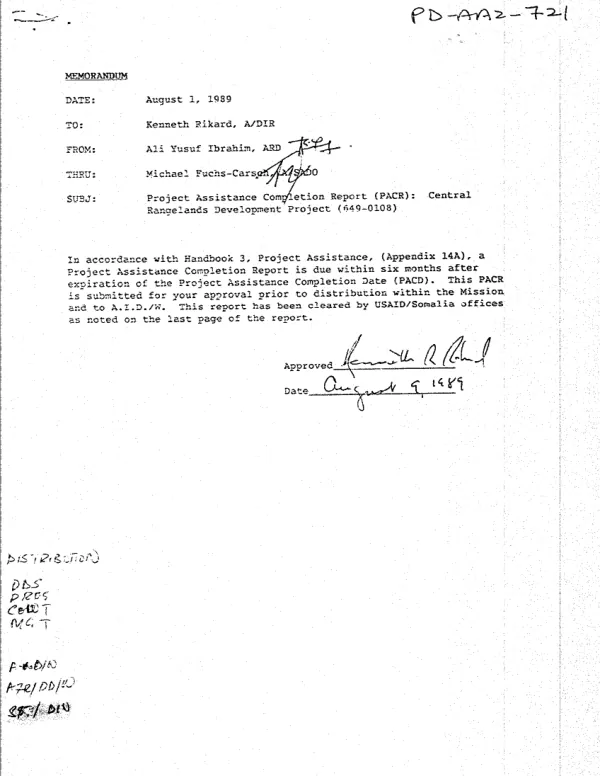
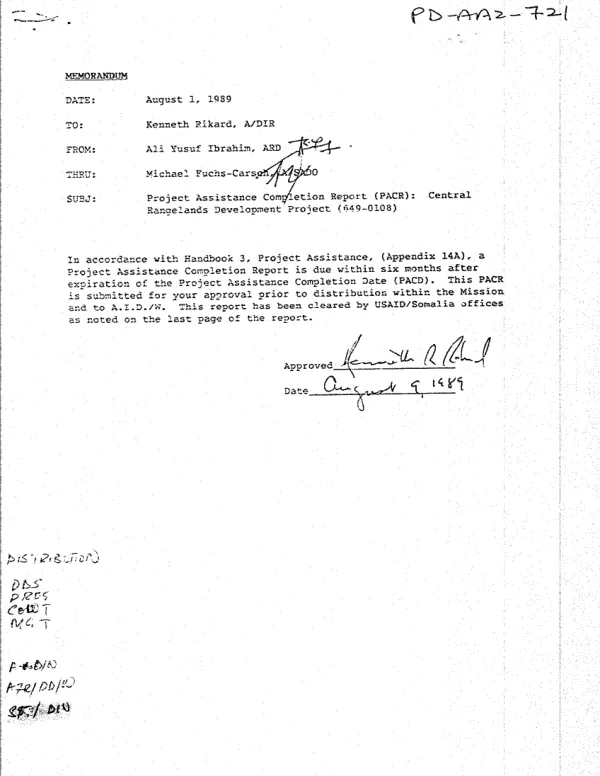
Project assistance completion report : central rangelands development project (649-0108)
Sign inUSAID. MISSION TO SOMALIA
Project assistance completion report : central rangelands development project (649-0108)
PACR of a project (8/79-6/89), part of a multi-donor effort, to improve range management in Somalia"s Central Highlands.
1989
Sign in to readA free account is required to download.
Abstract
Despite not having fully achieved its targets, the project leaves behind a sound technical base for future development of the Highlands and a solid cadre of trained professionals. Little progress was made during the early years due to an overly ambitious project design, lack of coordination among donors and between project headquarters and field staffs, and security problems in some areas. In 1984, the target area was reduced by 75% to 3 priority districts (3 additional districts were added in 1987), and implementation improved. Shortfalls were mainly caused by external factors such as lack of fuel for field work, lack of incentives and per diem funds, and the failure of participants to return from training. An aerial survey of the entire Central Rangelands area and ground surveys for 5 districts are complete; a second aerial survey was canceled due to contracting problems. The project developed range management plans for 23 degaans (traditional grazing areas) and established range and livestock associations for 16 degaans. Staff also collected numerous plant samples, but analysis was not performed due to delays in acquiring laboratory equipment. Only about half of the planned water development activities were accomplished, due in part to inadequate hydrogeological knowledge in the early stages, which resulted in many dry or brackish wells. Project boreholes proved detrimental since they provide a permanent water supply, encouraging overgrazing in surrounding areas. The soil and water conservation component established nurseries to produce seedlings for village shelterbelts and sand dune stabilization, but construction of berkets (water collection basins), water spreading activities, and shelterbelt and dune planting were hampered by lack of fuel and heavy equipment maintenance. The use of animal traction could have alleviated these problems. Four herds of camels, sheep, and goats were selected by the animal husbandry specialist for monitoring livestock production data. This valuable work should be continued. The project established a Botany and Range Science Department at Somali National University, from which 56 B.S. students have graduated. However, the future of the Department is uncertain due to the very low rate of return of participant trainees. So far, only 12 of 18 range science students have returned, and none of the 7 participants trained to assume professorships has returned, though 2 are expected shortly. Expatriate and Somali personnel in the range and university components produced a wealth of scientific publications which will form the basis for much future work in the Central Highlands. Two major lessons were learned. (1) Project design should involve critical assessment of pre-project assumptions. (2) The difficulties of coordinating a multi-donor project can be alleviated by formation of a steering committee, but it is better if each donor be responsible for an entire project or subproject.
![Project assistance completion report [: improvement of tomato production in Somalia]](https://covers.devme.ai/gen/9227.webp)
![Project assistance completion report [: refugee self-reliance project 649-0123]](https://covers.devme.ai/gen/9532.webp)
![Project assistance completion report [: improvement of tomato production in Somalia]](https://covers.devme.ai/gen/54432.webp)