USAID. MISSION TO CHAD
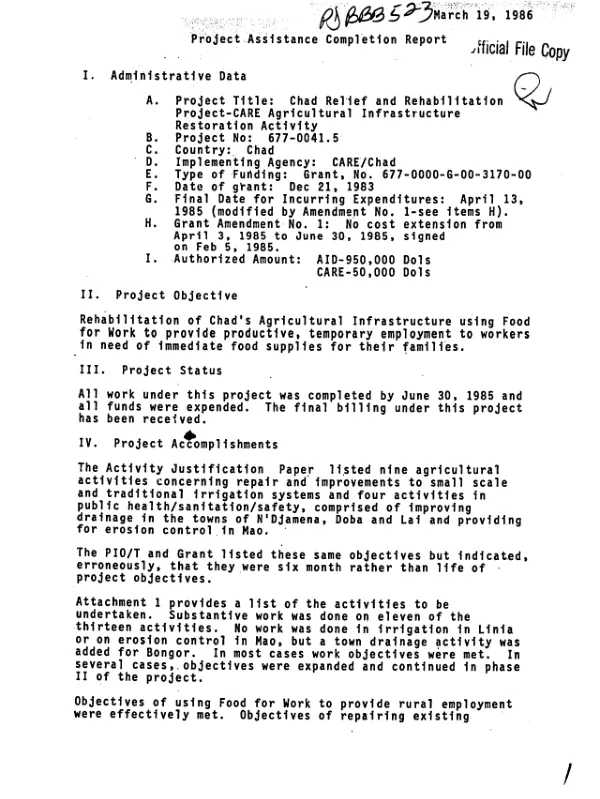
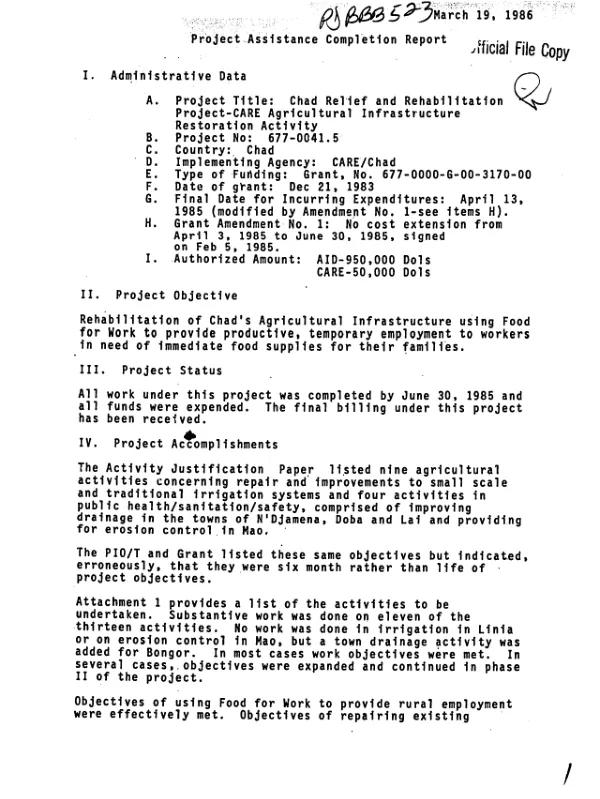
Project assistance completion report : Chad relief and rehabilitation
Presents final Mission report (12/83-6/85) on a subproject (SP) of the Chad Relief and Rehabilitation Project to rehabilitate Chad's agricultural infrastructure.
Sign in to readA free account is required to download.
Abstract
The SP, implemented by CARE, ended in 6/85 after a 4-month no-cost extension. Of the 13 activities planned (9 in small-scale irrigation and 4 in public health, sanitation, and safety), work was done on all except for irrigation in Linia and erosion control in Mao. A town drainage system was added for Bongor. The goal of rehabilitating irrigation infrastructure at selected sites was largely met, and Food for Work was effective in generating rural employment. Less well documented were the SP's benefits to the users of the rehabilitated infrastructure. Status on recommendations of the 6/84 mid-term evaluation is as follows. (1) The recommendations to implement a second phase of the subproject and to include in it greater planning detail regarding materials, targets, beneficairies, level of effort, and budget, were fully acted upon. (2) In response to the recommendation to reinforce the project's engineering aspects, CARE recruited an irrigation engineer in early 1985, but terminated this assignment by mutual consent after 4 months; the individual was not replaced. Subsequently, USAID/C added an engineer to its own staff and requested more detailed engineering plans for review prior to phase II implementation. (3) Despite the recommendation that CARE submit more complete and timely activity completion reports, reports continued to be too limited in scope, often focusing on timeliness of input delivery and neglecting to discuss the activity's relative merit in light of the overall project purpose. (4) CARE provided a short-term rural sociologist/anthropologist, as recommended, to analyse impacts on users of the rehabilitated infrastructure. However, the usefulness of the final report was flawed by its focus on describing ethnic societies, although it did indicate a very strong interest by traditional villagers in irrigation development. Two lessons were learned. (1) The use of umbrella financing proved a flexible and effective method of rapid response to Chad's war and drought-related emergencies. This was especially true in this project because of CARE's extensive previous experience in Chad. (2) Meeting technical engineering criteria for irrigation infrastructure rehabilitation may require professional support beyond a PVO's ability to recruit. Such expertise could be built into the central, supervisory part of a PVO umbrella project, or could be arranged by the individual PVO through agreements with a university or an agricultural engineering firm.
![Extending successful hospital-based child survival strategies into surrounding urban, peri-urban, and rural communities of Boaco, Nicragua : CS-VII [child survival], grant no. PDC-0500-G-00-1064-00 -- final evaluation, September 1991-February 1995](https://covers.devme.ai/gen/5755.webp)