USAID DEC
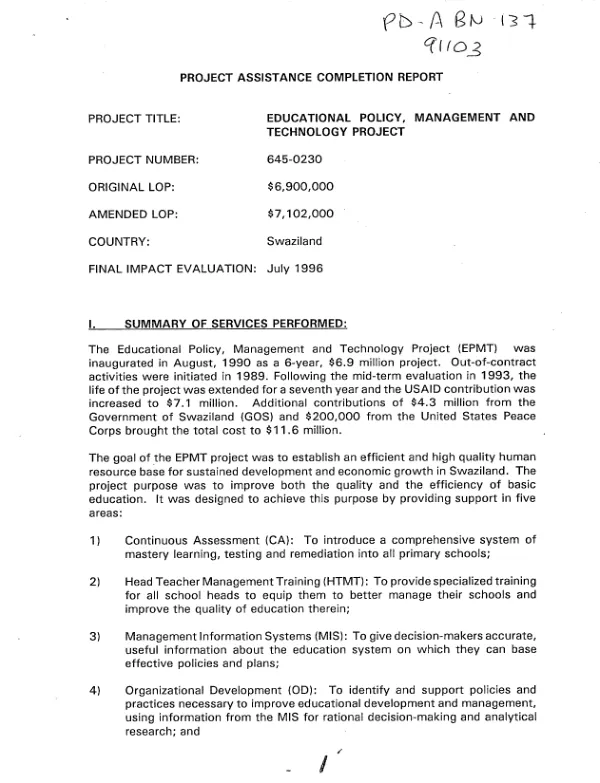
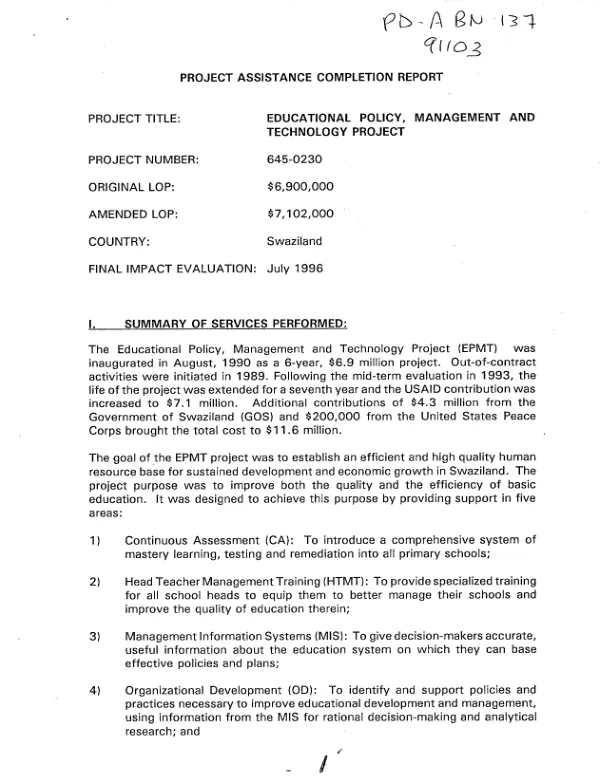
Project assistance completion report : educational policy, management and technology project
Sign inUSAID. MISSION TO SWAZILAND
Project assistance completion report : educational policy, management and technology project
Final evaluation of a project (8/90-8/96) to improve the quality and the efficiency of basic education in Swaziland.
1996
Sign in to readA free account is required to download.
Abstract
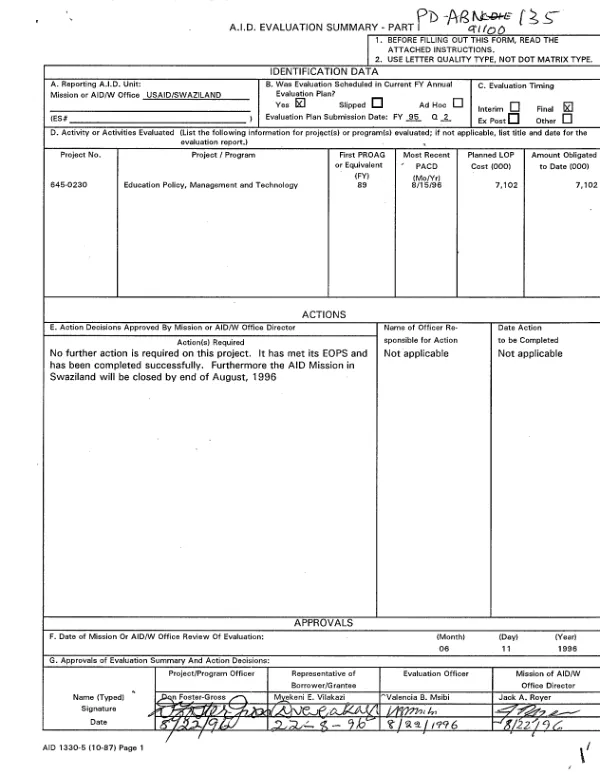
The Institute for International Research (IIR) was the implementing agency. This ambitious and complex project attained its purpose and met its objectives. (1) The number of students graduating on time from grade 3 has increased from the 1989 base, repetition and drop-out are on the decline, and children are learning more and better. (2) Teachers of grades 1-4 are applying continuous assessment (CA) to teaching Mathematics and English, and teaching has become more interactive. These educational tools have improved children's learning, giving real meaning to the motto "every child is a successful learner." Core personnel are committed to CA and capable of expanding it to other subjects and to grades 5-7. (3) Head teachers have the skills and understanding needed to manage their schools better. (4) The Ministry of Education (MOE) is using empirically generated data to make policy and planning decisions. (5) There is increased awareness among students of career choices and resources for identifying employment options. In many areas, the project achieved more than it had originally envisioned, enabling the MOE to embrace reform and effect an efficiency-effectiveness-quality paradigm shift. For example, head teacher management training has improved school management at the primary and secondary levels and previously strident press criticisms have dwindled noticeably. The in-service teacher training department (INSET) team has embraced training methodologies developed early in the project and conducted, independently, five cycles of training throughout the country. INSET has so matured that it is planning a program to devolve in-service work to the school level. In addition, a Management Information System (MIS) capable of providing information on demand is in place. Six years ago the MOE was criticized by a public sector review for its extremely weak planning capacity and its lack of the information needed to make rational decisions. Today, the unit has a policy support model which it has used to analyze and determine policies and programs. A teacher data base has helped the MOE rationalize the teaching force at a time when resources are becoming increasingly constrained. Organizational Development (OD) work has helped the MOE use MIS data to establish coherent and useful policies and procedures. A National Education Symposium allowed 400 prominent people to review the state of education in the country and lend support to the MOE's reform efforts. The symposium marked a turning point by galvanizing the education sector and the community at large. In addition, a Quality Working Group began planning a school program to improve effective learning, and a committee of The National Education Strategy prepared, under the motto "Our Children First", a strategy for education until the Year 20/20, embracing basic education, CA, and improved school management and autonomy. The OD component also assisted in the area of donor coordination. Above all, it helped bring into the open the need and desire for reform as originally envisioned by the National Education Review Commission (NERCOM) report of 1985 and the project design. The National Development Strategy (NDS) Education Sector Committee has recommended establishment of a group to initiate, monitor, and sustain educational and training reform. The Project Steering Committee, which will continue to function as the "Basic Education Steering Committee", included interest groups in its discussion and decision-making, thereby reaching decisions acceptable to the majority of parties involved. Such is the stuff of reform. Overall, the project has contributed to two of USAID's pillars of development assistance: economic growth, by helping to establish an efficient and high quality human resource base needed to work toward the goal; and democracy and governance, by lighting the way toward transparent and open development. For lessons learned, see the abstract of PD-ABN-135.
![Project assistance completion report [: health planning and management, Swaziland]](https://covers.devme.ai/gen/9681.webp)