USAID. MISSION TO SWAZILAND
Project completion report : University College of Swaziland
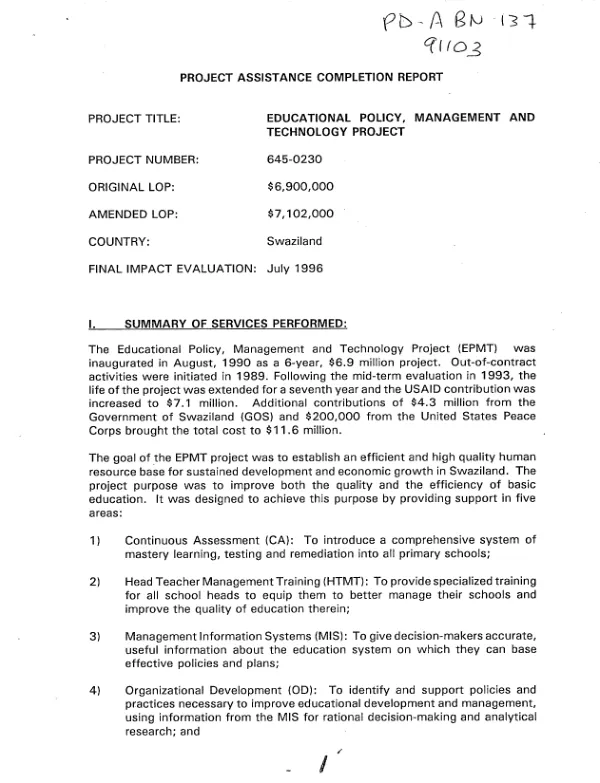
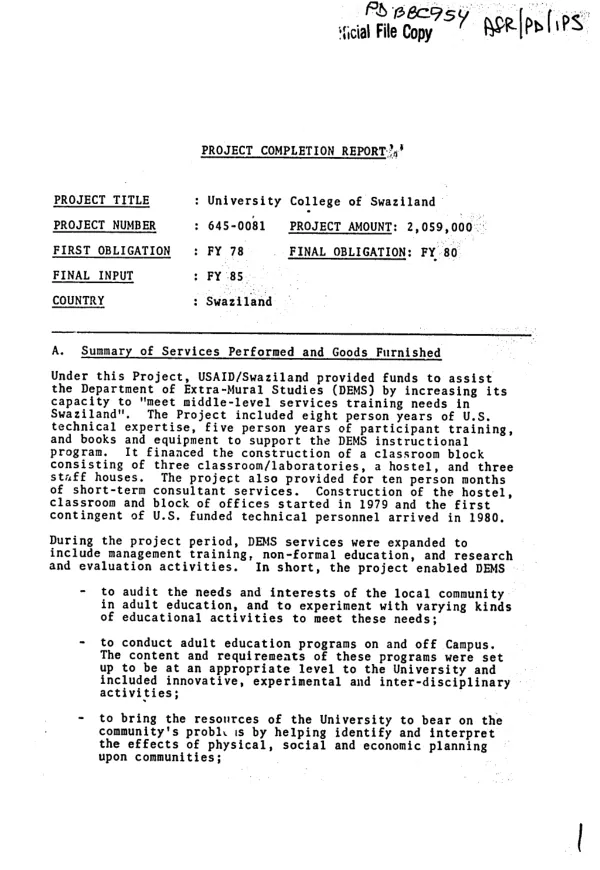
Presents final Mission report on a 1978-85 project to increase the ability of the University College of Swaziland's (UCOS) Department of Extra-Mural Studies (DEMS) to provide mid-level training.
Sign in to readA free account is required to download.
Abstract
The project fell far short of its grandiose aims. Inservice diploma courses in adult education and management were discontinued due, respectively, to low enrollment and staffing problems, while the provision of academic tutorial assistance to UCOS extension courses in business and education has been halted by a lack of demand which has forced DEMS to shift its focus from mature students to school leavers who probably should be taking trade and technical courses instead. The objective to have UCOS student volunteers promote development by teaching academically certified adult education courses in rural areas was ill-conceived. It was unlikely that students could provide such training or that, as first generation students in a university based on the British academic system, they would be willing to return to their roots in order to effect beneficial change there. The Project Paper never even addressed the inappropriateness of mounting sophisticated programs for rural people. Finally, while a student hostel, classrooms, and block of offices were built as planned, the facilities are being used for UCOS rather than DEMS purposes, as there was little demand from DEMS for their use (as noted as early as the 6/80 PES). Perhaps DEMS' greatest accomplishment was its preparation, in compliance with a candid assessment by the National Association of Schools of Public Affairs and Administration, of a Five-Year Plan focused on providing management training to small, rural enterprises rather than, as in the past, to larger private sector firms and parastatals. USAID/S has already received positive feedback on this shift in DEMS' program emphasis. The project suffered from several design and implementation flaws. Originally designed to serve Botswana, Lesotho, and Swaziland, the project was developed at a time when the triad of universities in these three countries was beginning to dissolve. Further, DEMS was headed by a non-Swazi, although the nature of its work almost demands Swazi leadership. Only one U.S. institution (the University of Massachusetts) responded to the 4/79 RFP and its performance was below par almost from the start. Also, a new Work Plan should have been devised after the 6/82 PES; U.S. Masters programs for the three participants were inadequately planned; and the lack of U.S. technical advisors (despite the contract with a U.S. institution) directly affected the USAID/S-DEMS relationship and the degree of commitment USAID/S was able to extract from the advisors.
Related documents