USAID. MISSION TO SWAZILAND
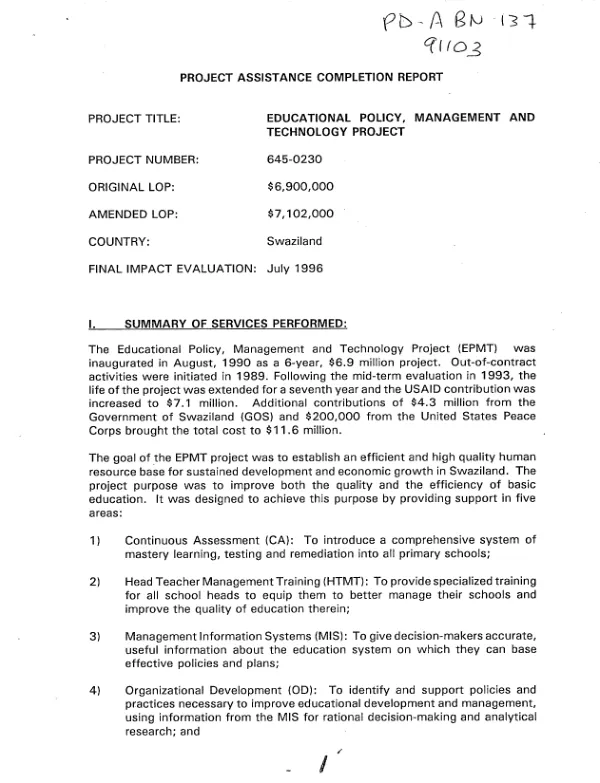
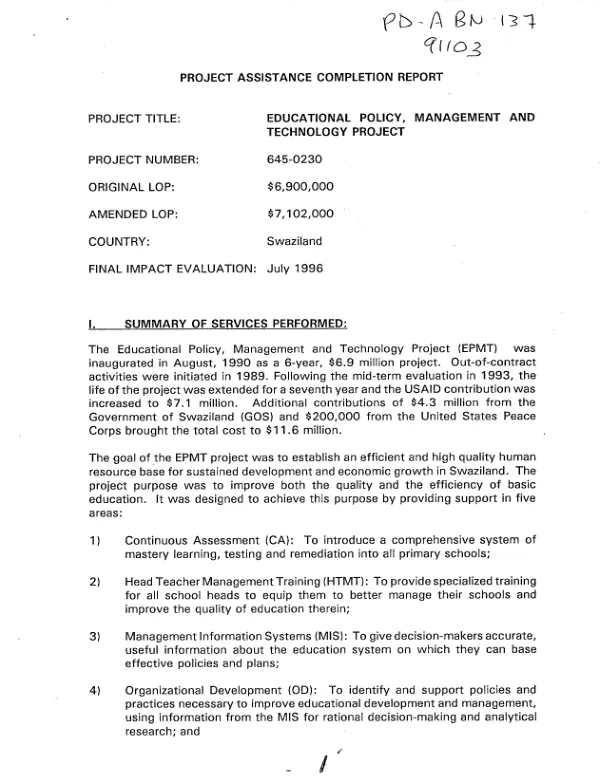
Education policy, management and technology
Summarizes final evaluation (PD-ABN-363) of a project (1989-8/96) to improve the quality and the efficiency of basic education in Swaziland.
1996
Sign in to readA free account is required to download.

Abstract
The Institute for International Research (IIR) was the implementing agency. The project has produced a long list of impressive outputs and educational inputs; two key areas of activity were training and the production of educational materials. Further, the project has had a profound impact on the quality of education in Swaziland. The center of gravity in the classroom is being shifted from the teacher to the student and from teaching to learning. The project"s various components are sustainable given sufficient Swazi expertise and resources. The project"s major weaknesses stemmed from its design rather than its implementation. Since the USAID Mission in Swaziland is scheduled to close a month after project closure, major recommendations stem from "lessons learned" from the project as a whole rather than from lessons learned from each component, as the former may be applicable to USAID basic education projects in other countries. The most important lessons are as follows. (1) Long-term projects are needed in order to bring about sustainable change. This project was implemented over a period of 7 years. Shorter implementation periods do not bring about lasting change. (2) Flexibility is needed to allow projects to grow "organically" and shift emphasis in accordance with changing realities. The success of this project is a result of such a willingness to diverge from the project design. (3) Concentrating the provision of TA at the beginning of the project was beneficial. After completing the initial long-term contract of 2 years, TA personnel effectively handed over responsibility for project implementation to national counterparts. During the latter half of the project, key TA personnel were brought back for short-term consultancies to guide the local experts who had taken on the role of implementors. (4) Education projects that attempt basic, system-wide change should conduct formative evaluations throughout the life of the project. (5) Education projects that attempt to change teacher behavior should include pre-service teacher education. (6) Top-down approaches can lead to use of inappropriate technology. (7) Top-down attempts at behavioral change at the school level are inefficient and often alienate teachers. In USAID"s view, the final evaluation failed to appreciate the contribution of the management information systems (MIS) and organizational development (OD) components to the overall success of the project. While the Mission recognizes the validity of some of the evaluation"s arguments, it tends to agree with the project"s chief of party that the OD and MIS components were critical to the project"s success. A monograph is being prepared on the key elements that contributed to successful implementation of the project.