USAID DEC
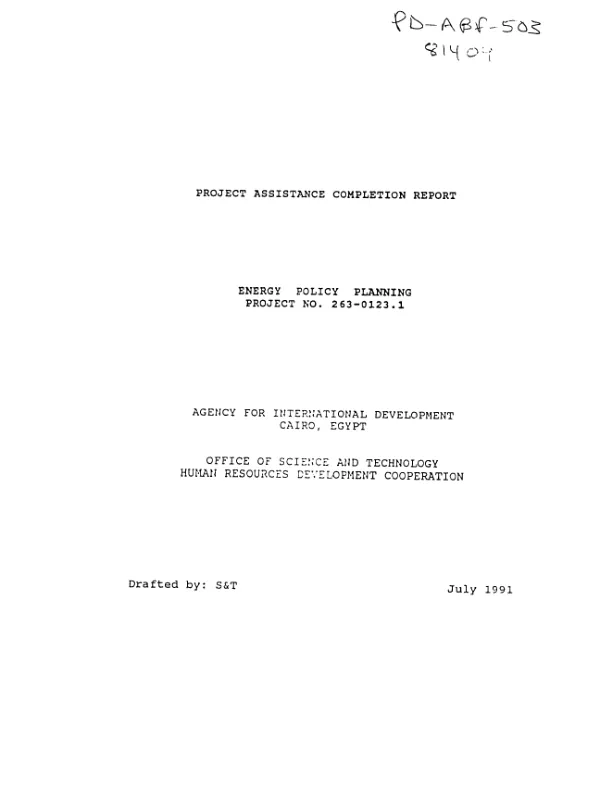
Project assistance completion report : energy policy planning, project no. 263-0123.1
Sign inUSAID. MISSION TO EGYPT
Project assistance completion report : energy policy planning, project no. 263-0123.1
PACR of a subproject (SP) to develop the Government of Egypt"s (GOE"s) capabilities to collect and analyze data needed for energy policy planning, focusing on institutional development of the Organization for Energy Planning (OEP).
1992
Sign in to readA free account is required to download.
Abstract
Final report covers the period 8/82-5/91. The SP succeeded in strengthening the GOE"s institutional capacity to process and analyze energy data by precipitating the creation of OEP, and met nearly all its numerical targets. However, OEP"s impact on the root problem of ineffective development and utilization of energy resources has been limited; while OEP has proved itself to be a competent analytical body, it lacks formal and informal mechanisms for feeding its analytical outputs into the GOE"s energy policy planning and decision-making process. OEP is taking steps to become a more active participant. All training under the professional development component was successfully completed, and in some cases, outputs exceeded expectations. An energy data collection system is in place and OEP has trained over 3,000 energy managers, primarily from the industrial sector. Fifty full-time specialists have been trained, compared to an expected 10 or 15. International experts conducted nine week-long training seminars on topics ranging from energy cogeneration policy to energy conservation in the transportation sector. Outputs of the special studies component included: (1) analyses of energy conservation in industry, agriculture, transforation, and cogeneration; (2) a high efficiency lighting demonstration for Nasr City hospital; (3) sectoral policy studies of energy consumption in industry and transportation; and (4) 16 in-depth energy audits of Egyptian industrial facilities, 11 in conjunction with U.S. contractors and 5 with the Government of Sweden -- the audits are being put to use under the Energy Conservation and Efficiency Project (2620140.3) Lessons learned, taken from the 4/89 evaluation, include the following. (1) Institution building of the sort attempted in this project is a long, complex process, requiring a commitment by A.I.D. well beyond the "incubation" stage. (2) Personal factors and dynamics, though difficult to capture in project plans, are extremely important in determining the success of institution building, suggesting a need for attention to process variables in project planning. (3) When choosing to use host country contractors, Missions should be ready to accept some loss of control. (4) Intermediate evaluations are powerful instruments for keeping a project in line with objectives. (5) For relatively long-term institutional development projects, plans should be written so as to allow considerable flexibility in responding to changing conditions; detailed plans can create problems for a project being implemented in the midst of uncertainty, because some of the partners are likely to take them seriously.