USAID DEC
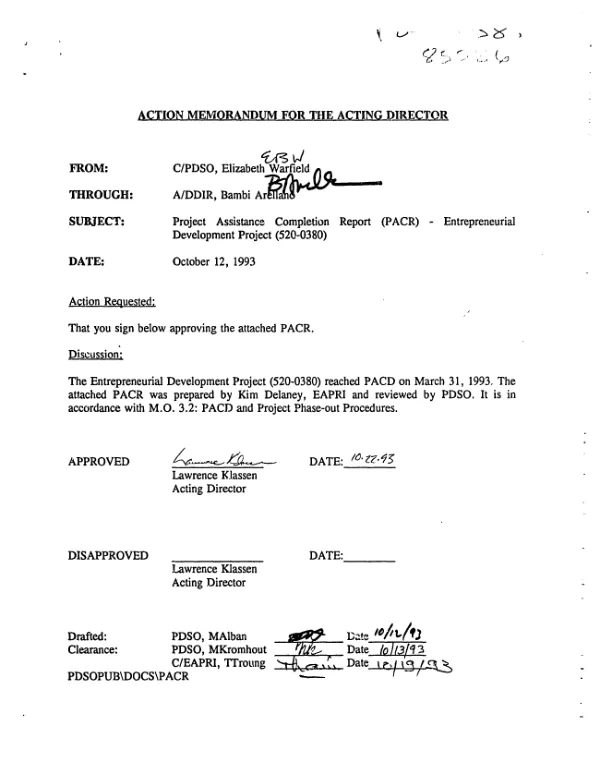
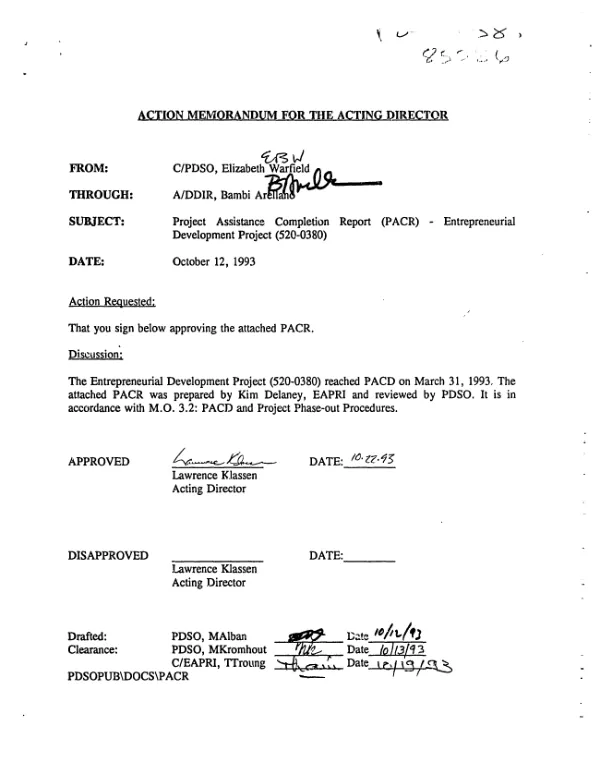
Project assistance completion report : entrepreneurial development project (520-0380)
Sign inUSAID. MISSION TO GUATEMALA
Project assistance completion report : entrepreneurial development project (520-0380)
PACR of a project (7/89-3/93) to support the development of small and medium-scale enterprises (SMEs) in Guatemala, and promote U.S.-Guatemalan joint ventures.
1993
Sign in to readA free account is required to download.
Abstract
The project was implemented by the International Executive Service Corps (IESC). While the project did not reach all of its goals, it did have a positive impact on SMEs, as demonstrated by increased sales and production. A survey of 95 assisted firms revealed that: 58% improved product quality; 56% increased their profits; 49% increased sales; 43% increased production; and 31% increased workers" wages. The most successful activity was the U.S. Volunteer Executives program, which provided management assistance and technology transfer to 139 firms; assistance went mostly to agribusiness enterprises, followed by woman-owned businesses and manufacturing firms. Although efforts were made to coordinate activities with local business associations, such as the Guatemalan Entrepreneurial Chamber (CAEM), the Guild of Non-Traditional Product Exporters (Gremial), FUNDAP, FUNTEC, and the Guatemalan Management Association, attention was not paid to strengthening these institutions" capabilities, but rather to tapping them as a source of potential clients. No progress was made under the Guatemalan Volunteer Executive program; deep mistrust and strong competition among Guatemalan firms prevented them from sharing with one another what was perceived as confidential business information. In the Trade and Investment Services (TIS) component, sector surveys were completed for a range of products in the agribusiness, manufacturing, wood, and metalworking sectors. However, no marketing and promotional efforts were developed for these sectors, nor were any joint ventures launched. However, the American Business Linkage Enterprise services did put a number of Guatemalan firms in contact with U.S. firms interested in investing in the region. As a result, two Guatemalan businesses entered into negotiations with U.S. firms, for a loofah export business and a data entry operation. Unfortunately, the negotiations were unsuccessful and neither transaction was completed. The following lessons were learned. (1) IESC should focus its efforts in its areas of strength. Although TIS activities have been successful in other countries, in Guatemala much more success was derived from Volunteer Executives. (2) In designing projects for SMEs, attention should be paid to ensuring that services are affordable. In the case of IESC/Guatemala, high local operating costs combined with mandatory fees to IESC"s U.S. headquarters gradually raised the cost of services (even with a large subsidy from the Mission) out of the reach of SMEs. Although efforts were made to work with IESC on alternative delivery mechanisms and operating procedures to lower their costs, there was a great deal of resistance to doing so, with IESC preferring to charge higher fees and move to larger clientele. (3) A monitoring system should be established that meets both A.I.D."s and the implementing institution"s needs. While IESC/G made every attempt to respond to the information needs of the Mission, their U.S. headquarters, and their clients, this distracted their attention from service delivery, a situation which would not have occurred if reporting needs had been thought through at the initiation of the project. Also, USAID/G changed project officers frequently and each officer had a tendency to place new reporting requirements, because of the lack of an adequate reporting/monitoring system.
Related documents