USAID DEC
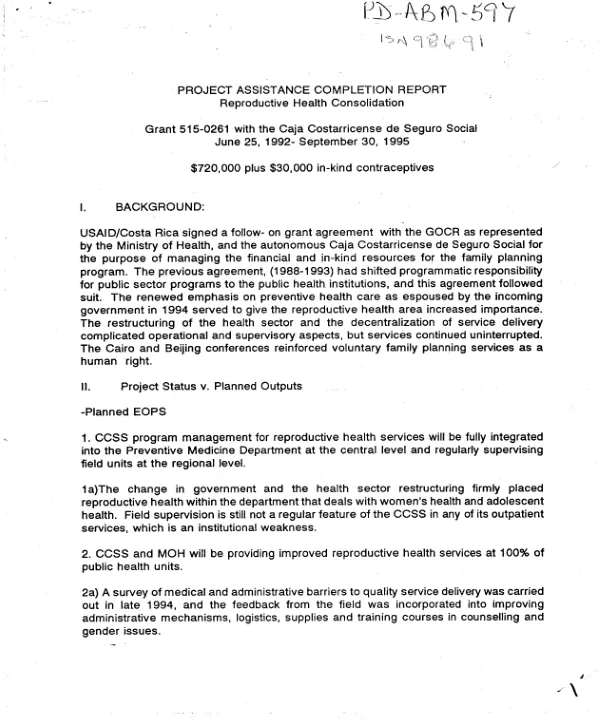
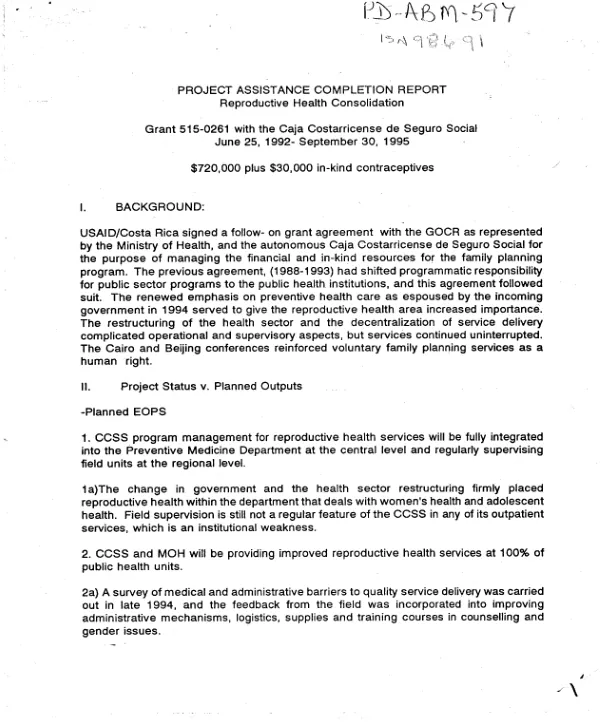
Project assistance completion report : reproductive health consolidation -- grant 515-0261 with the Caja Costarricense de Seguro Social -- June 25, 1992-September 30, 1995
Sign inUSAID. MISSION TO COSTA RICA
Project assistance completion report : reproductive health consolidation -- grant 515-0261 with the Caja Costarricense de Seguro Social -- June 25, 1992-September 30, 1995
PACR of a grant (6/92-9/95) to Caja Costarricense de Seguro Social (CCSS -- Costa Rica's social security agency) to improve public sector reproductive health (RH) services in Costa Rica, consolidate them under CCSS's direction, and make them self-sustaining.
1995
Sign in to readA free account is required to download.
Abstract
The project met most of its objectives. RH services have been institutionalized within the public sector's preventive health framework, and outpatient services have been regularly provided (although restructuring of the health sector and decentralization of service delivery complicated operational and supervisory aspects, services continued uninterrupted). The new CCSS management has focused on community-level multi-disciplinary RH teams, but services are still also provided at workplaces. Results from a 1994 survey of medical and administrative barriers to quality service delivery were used to improve administrative mechanisms, logistics, supplies, and training. Project training focused on medical schools, and on improving cervical cancer detection, counseling, and gender considerations. The 1994 survey indicated that the majority of family planning services in rural areas are provided by doctors in their social services practice, so there is increased interest in improving medical schools. Technical teaching guides that were evaluated by USAID/W clinical training projects were given high marks. Moreover, CCSS is now procuring (with domestic resources) all the oral contraceptives, condoms, IUDs, and injectables needed by the public sector. Other activities included operations research, analyses of data from contraceptive prevalence surveys carried out under the predecessor project, and continued use of media and printed information, education, and communication (IEC) materials from the last project. Costa Rica's strong public sector RH program may not be easily replicable. Demand is greater in the public, pre-paid CCSS sector and the MOH than in the significantly higher cost private market. Private subsidized services are essentially limited to a nonprofit hospital that cross-subsidizes services; no major NGO is involved in clinical services, which is a very different situation from most Latin American countries. The project strengthened this environment of state-supported services, while at the same time supporting successful implementation by CCSS of different administrative models for outpatient services. Over the course of the project, the stigma of an implied imposition of policies by external entities has been overcome; and leaders from all walks of life accept the philosophy and activities of the RH program, including sex education at early ages. However, it should be noted that women's educational levels, rural residence, and socioeconomic status are still major indicators of differences in fertility, with educational levels the leading variable.
Related documents
Documents in this collection
 1995
1995USAID DEC
Project assistance completion report : reproductive health consolidation -- grant 515-0261 with the Caja Costarricense de Seguro Social -- June 25, 1992-September 30, 1995
Open record 1992
1992USAID DEC