USAID. MISSION TO GUATEMALA
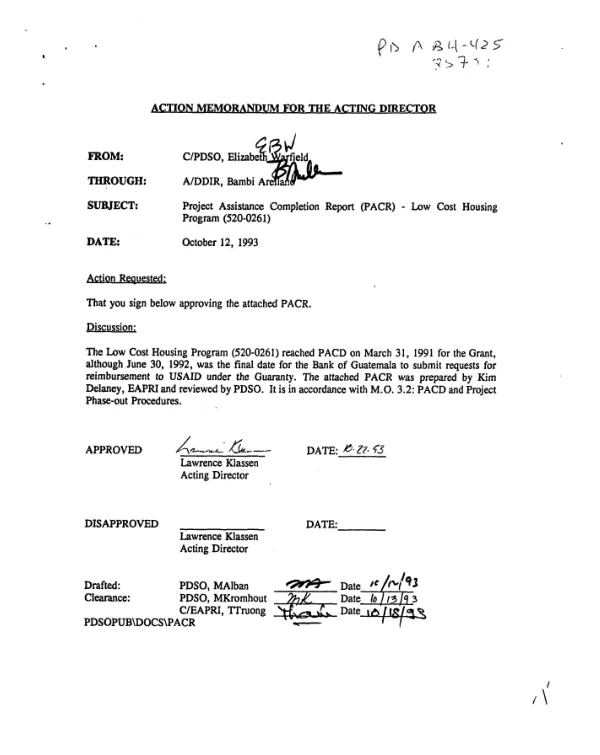
Project assistance completion report : low-cost housing program
PACR of a program (9/82-3/91), comprising Housing Guaranty (HG) 520HG04 and grant-funded TA (5200261), to increase the private sector's role in financing and constructing low-cost housing in Guatemala.
1993
Sign in to readA free account is required to download.
Abstract
The program was implemented by the Bank of Guatemala (BOG) and the Guatemalan Mortgage Insurance Institute (FHA). Program start-up was significantly delayed; in the absence of a Guatemalan institution with experience in housing matters, and after several years of negotiation, the BOG assumed responsibility for program implementation in 1986. However, the Bank itself had no experience in housing policy or project implementation, and was further constrained by the country's lack of policies related to subsidies and interest rates. Despite these problems, the program has had a positive effect. It successfully guided the FHA to lower minimum standards to a 13 sq meter shelter solution, thereby expanding the housing market to include lower-income groups. Private developers were also encouraged to promote minimum standard shelter solutions, and in 1991 developers began providing housing units of 28 sq meters. A total of 1,851 low-income housing units were built over the life of the program, providing jobs to approximately 850 construction workers at the peak construction phase. A shelter network comprising some 35 public and private institutions was established, provided significant support to housing leaders, and drafted and submitted to Congress a new housing law. Seminars, short courses, and conferences helped members of the FHA, BOG, the Guatemalan Construction Chamber, and various cooperative organizations participate in promoting needed changes. The private sector was heavily involved in the provision of shelter solutions; after the program was reactivated in 3/91, five private developers completed approximately 50% of the program's housing units. A follow-on program is not recommended until there is a clear political commitment on the part of Guatemalan government to establish an appropriate policy framework to support low-income housing production. The following are lessons learned. (1) The immense shelter problems in Guatemala will not be solved by piecemeal housing and community development projects. (2) Guatemala's shelter problems must be solved with local human and financial resources, and without dependence on external financing and assistance. (3) The Government must establish a permanent financing and policy institution in charge of the shelter sector. This institution should include the creation or transformation of institutions to become "second floor" developing/financing entities, and the provision and utilization of public and private resources.