USAID DEC
Project assistance completion report (PACR) : computer technology, project no. 664-0334
Sign inUSAID. MISSION TO TUNISIA
Project assistance completion report (PACR) : computer technology, project no. 664-0334
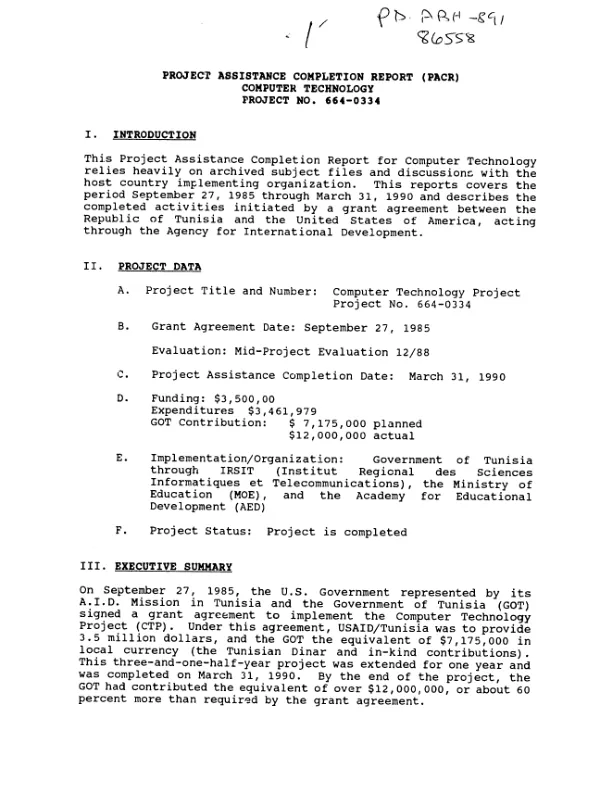
PACR of a project (9/85-3/90) to institutionalize within the Government of Tunisia (GOT) the capacity to use computer technology, especially in public education and research.
Sign in to readA free account is required to download.
Abstract
The project was implemented by the Institute Regional des Sciences Informatiques et Telecommunications (IRSIT). IRSIT is now a leader in computer technology in North Africa. In five years, the time it usually takes for an applied group to develop, IRSIT has not only established itself but increased its staff of scientists and researchers from 3 to 35 in number, and developed its reputation in Tunis as a well-trained and technically up-to-date (i.e., U.S. educated), and hardworking group that is able to respond quickly to demands. Government funding of IRSIT has decreased to 45%. In addition to strengthening IRSIT, project outputs include, inter alia: 6 long-term relationships with private Tunisian companies; 8 linkages with U.S. universities or computer companies; production of the first satellite maps in North Africa; installation of microcomputers at pilot schools; and pilot projects in higher and secondary education and applications research. The following lessons were learned. (1) Effective institutional linkages must be based on mutual benefits between the institutions. This often requires considerable time and exchange between the institution and the potential partner just to recognize the mutual benefits. The time and cost (particularly that related to communications) must be included in schedules and budgets. (2) Being the first or only user of any hardware or software in a country has several disadvantages. "First and Only" users experience the most severe maintenance problems. This guideline may conflict with the desire to be a technology gateway, so a balance must be reached. (3) Buy for quality rather than price; because of the cost and difficulty of maintenance in Tunisia, it was wiser to pay costs up front, and purchase more expensive high-quality equipment, which fails less often. This minimizes work disruptions. (4) At least 10% of equipment costs should be budgeted for maintenance and/or spare parts. It is important to investigate the willingness of local vendors to service equipment procured directly from the United States (5) Short-term professional training proved to be a very effective way of augmenting the technical education of B.S. and M.S. level staff. For those with a Ph.D., however, short courses must be carefully screened to ensure high quality. Staff and management beyond the Ph.D. level generally benefit most from seminars, conferences, and meetings with executives and staff of cooperating institutions. (6) The project helped the GOT develop its plan to establish an international institution of higher education, called the Carthage Institute of Technology (CIT), but the plans were never executed. Development of such an institution required considerable long-term political and non-political support within a country. It also requires exceptional stability within the government. Tunisia's change of government and successive appointment of three Ministries of Higher Education during the CIT project made it difficult to achieve the necessary long-term stability.