USAID DEC
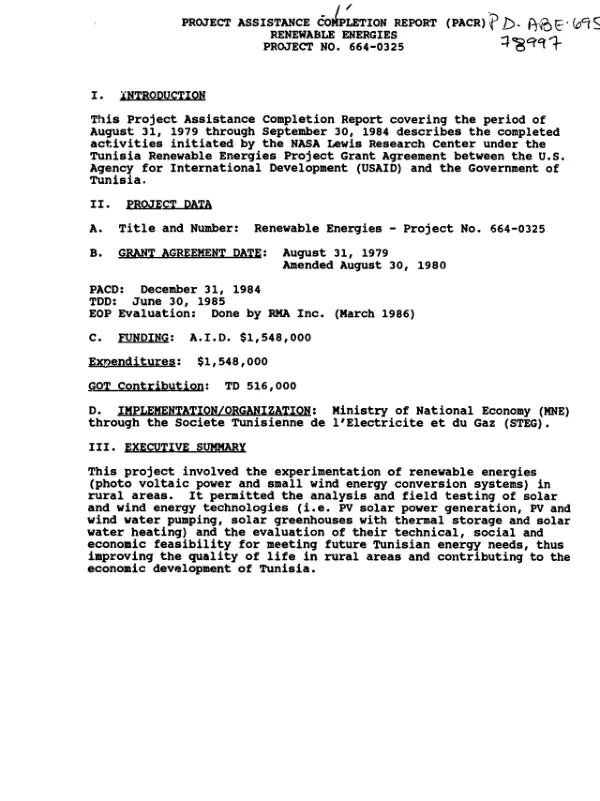
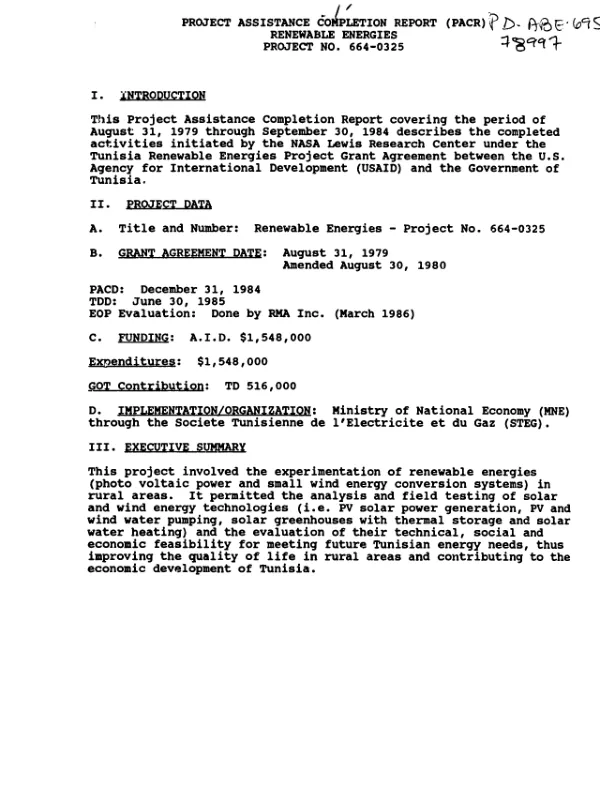
Project assistance completion report (PACR) : renewable energies, project no. 664-0325
Sign inUSAID. MISSION TO TUNISIA
Project assistance completion report (PACR) : renewable energies, project no. 664-0325
Presents final Mission report on a project (8/79-12/84) to test renewable energy systems in rural areas of Tunisia.
1991
Sign in to readA free account is required to download.
Abstract
The project was implemented by the U.S. NASA Lewis Research Center. The project succeeded in installing a very expensive experimental solar energy system in Hammam Biadha, a village 150 km southwest of Tunis. Hammam Biadha is a village of about 150 people, with a primary school for 500 students, stores, a mosque, and a public well. Most of the residents are engaged in smallholder agriculture. At a cost of $1.4 million (USAID) plus 160,000 Tunisian dinars provided by the Government of Tunisia, a 20 kw photovoltaic electrical system was installed to supply residential, commercial, and institutional users. Data on performance, consumption, demand, costs, etc. were collected over a 5-year period. Residential uses were mainly for lighting, TV"s, and in the summer, refrigeration. Both capital and installation costs were heavily subsidized by USAID. Each household was connected free and pays only the nationwide use rate for electricity, even though photovoltaic current is much more costly to produce than is conventionally fueled electricity. Diesel-produced electricity is the preferred system because of less capital investment, despite more frequent maintenance and higher operational costs; a diesel system for the village would have produced a real user cost of about one-third the solar cost. Part of the high capital cost was due to the "Buy American" requirement, which added 100% to equipment costs. U.S. consultant fees were also high (local skills, however, were substantially improved by project training). Agricultural applications of the new village solar system included three solar heated greenhouses -- which also seem to have economic feasibility problems. They are plastic tents with expensive foundations, which were given free to farmers on a pilot basis. Another application, a photovoltaic-powered water pumping system for drip irrigation systems, has encountered technical problems; moreover, farmers prefer the faster diesel irrigation pumps. There is little evidence that either productivity or the local economy were helped by the project. On the plus side, the system is operating well and keeps up easily with demand. Also, two small wind electric generators installed by the project at El Haouaria, an isolated and unattended site near the Mediterranean Sea, have provided an excellent additional wind energy resource.
![Project assistance completion report [PACR] : family planning and population development, project no. 664-0331](https://covers.devme.ai/gen/24673.webp)