USAID DEC
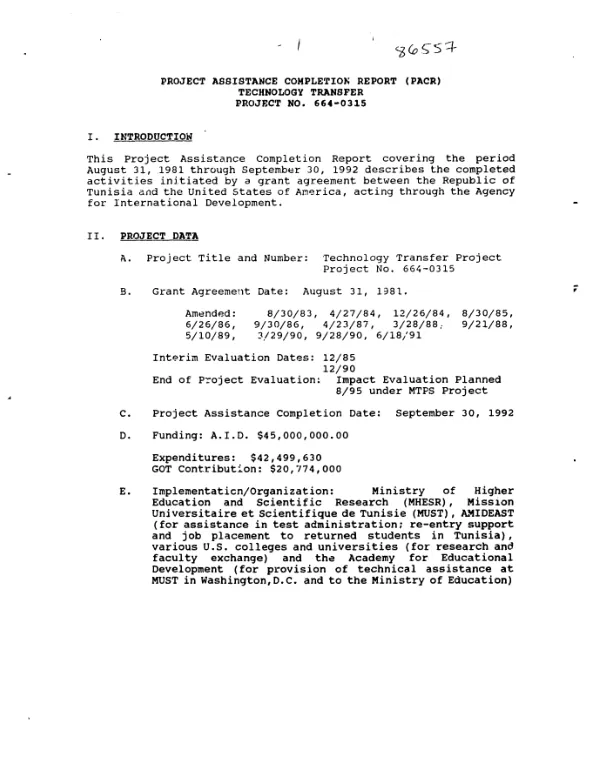
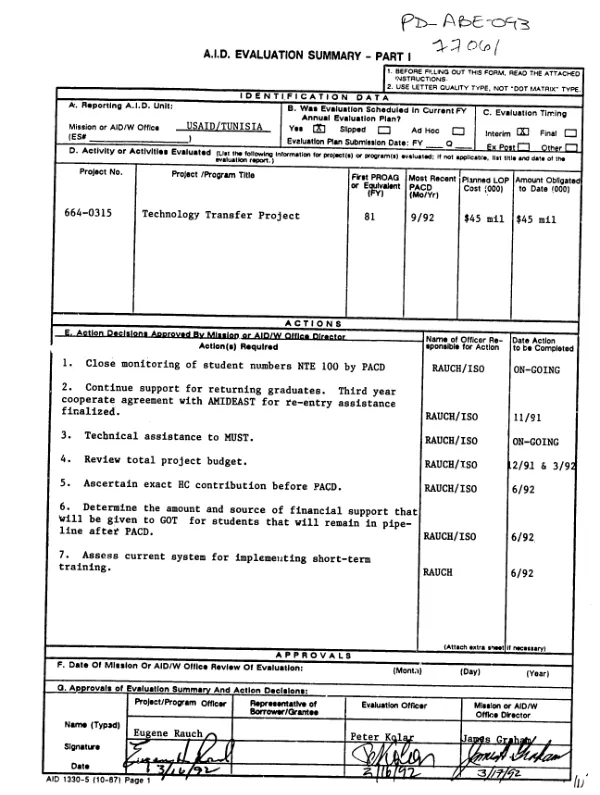
Project assistance completion report (PACR) : technology transfer, project no. 664-0315
Sign inUSAID. MISSION TO TUNISIA
Project assistance completion report (PACR) : technology transfer, project no. 664-0315
PACR of project (8/81-9/92) to provide U.S.
1970
Sign in to readA free account is required to download.
Abstract
training for Tunisian science and engineering students. The project has achieved its purpose and has increased the pool of highly skilled individuals able to help Tunisia develop a competitive market economy. Preliminary indications are that its impact on the economy, in particular the private sector, has been positive. Thanks to dialogue with the private and public sectors, project training was provided in appropriate fields. Also, in contrast to earlier reports that a U.S. degree was considered a handicap in finding a job in Tunisia, the Tunisian business community has found that U.S. graduates possess important leadership qualities and the potential to hold key positions as managers and directors. However, only 60% of participant trainees have returned to Tunisia, a fact that has had some impact on Government of Tunisia (GOT) thinking on its financing of overseas scholarship programs. The GOT has instituted schemes to recover the costs of educating non-returnees and now requires all overseas students to promise in writing to return to Tunisia and work at least 10 years. The goal of influencing GOT personnel planning was not achieved; the GOT has never been motivated in this area. Also, efforts to establish links between U.S. and Tunisian technical institutions ended in 1986 when the allotted portion of the budget ran out; as a result, Tunisian curricula were not upgraded, and the country remains dependent on overseas education. Lack of degree equivalence is another problem -- the GOT has not kept its promises to resolve this issue -- and a major contributing factor to the non-return of Ph.D.s. Despite the low return rate, in recent years the likelihood of returned trainees remaining in Tunisia to work after visa stipulations are met is rather high in contrast to 12 years ago. Thus, at least in the short-term, the newly acquired skills are being applied to GOT development. In addition, the GOT is quick to point out that Tunisians working outside the country will probably return eventually and are already sending money or gifts home to relatives and in this way contributing to the economy. The following lessons were learned. (1) Funding of back-to-back degrees should be avoided. It is extremely difficult to reintegrate into Tunisia students who have been absent 8-10 years, having left at age 18. (2) Restriction of extensions is imperative if students are to return home quickly. The longer students are provided security through scholarships, the less likely they are to be prepared to face the job market. (3) The liberal policy of allowing students to return home for summer break was costly because it precluded attendance at summer school, kept students from participating in short courses or internships that could enhance their employment chances, and diluted the pain of separation from family and friends and weakened the incentive to return to Tunisia promptly after finishing their degree. (4) Re-entry counseling and job placement services by AMIDEAST contributed greatly to the number of students returning and finding work. (5) Use of the Fixed Amount Reimbursement (FAR) method to finance scholarships caused USAID/T to lose control of the project because it did not provide an accurate way to measure the time needed for degree completion; using PIO/Ps would have been better. (6) It is essential to have an in-country counterpart to ensure smooth running of the project. In 1989, when the GOT began implementing the project through a Washington, D.C., office, the project became quite time-consuming. Even when, at USAID insistence, a counterpart in Tunis was named, that person could make no decision without clearance from Washington, causing constant delays in the submission of reports to the point where USAID was at times literally forced to make tuition payments just to keep students enrolled. (7) The GOT"s liberal policy of supporting students through as many as three university degrees is disguised welfare and contributes to the creation of an intellectual cadre ill-prepared for the realities of occupational life.
Related documents