USAID DEC
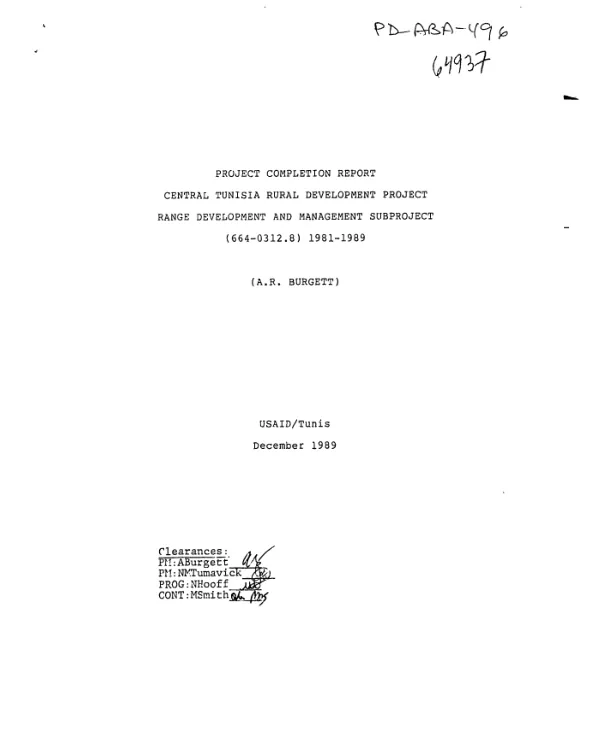
Project completion report : central Tunisia rural development project range development and management subproject (664-0312.8), 1981-1989
Sign inUSAID. MISSION TO TUNISIA
Project completion report : central Tunisia rural development project range development and management subproject (664-0312.8), 1981-1989
PACR of a subproject (1981-1989) to provide TA and training to the Office de l'Elevage et des Paturages (OEP) for the introduction of improved rangeland management systems in Central Tunisia.
Burgett, A. R. · 1989
Sign in to readA free account is required to download.
Abstract
Project activities changed drastically after the first 3 years when it was determined that rangelands were too depleted to benefit from improved rotation and range management systems. In order to correct this problem, the project was amended to establish a seed production/marketing unit to facilitate reseeding of the degraded rangelands. However, the seed component never operated efficiently because of droughts, changes of sites each 3 years, and insufficient support from research and extension. The project introduced improved range and herd management systems to stock raisers on 25 sites (covering 27,000 ha). At least three of the sites demonstrated improvements sufficient to encourage other farmers to adopt the new practices. In total, 6,000 farmers improved range production and sheep-raising practices, and 5,000 planted forages, cactus, acacia, and shrubs. In addition, the project provided ammoniated straw to 600 farmers, nearly 50% more than originally planned, while provision of feed concentrate was less than expected due to low demand. In general, the project's high rate of farmer participation is attributed primarily to large subsidies for animal feed and concentrate, rather than a motivation to implement new technologies. It is doubtful that farmers will continue to use the technologies once subsidies are removed. Moreover, there is no evidence that the project resulted in an expansion of meat or wool production. The project was also constrained by land fragmentation and relatively small farm size. On collective land, progress was limited by a lack of management leadership, both from local farmers and from the Forest Service. Problems also arose with the short-intensity grazing management system, under which shepherds had to split flocks between theirs and the landowners'. The system failed because shepherds had double work and no immediate benefits. Applied research was successful, especially during the first three years. Staff tested local varieties of seed and developed prototype farm equipment that was used by the project and could be produced locally at relatively low costs. A follow-up program needs to be implemented to market this equipment. The project was successful in strengthening the OEP Range Management Unit by training to BS and MS degree level 24 of its staff members. The Unit is capable of continuing to introduce improved range and herd management systems to stock raisers. Annexes provide technical information and detailed recommendations covering supplemental livestock feeding, forage production, forage calendar, dipping pools, genetic improvements, range improvements, water retention basins, equipment development, seeding techniques, ripping rangelands, grazing management, and establishment of cactus and acacia.