USAID DEC
Project assistance completion report (PACR) : rural potable water institutions project no. 664-0337
Sign inUSAID. MISSION TO TUNISIA
Project assistance completion report (PACR) : rural potable water institutions project no. 664-0337
PACR of a project (4/86-6/92) to increase the potable water supply in Central Tunisia.
1970
Sign in to readA free account is required to download.
Abstract
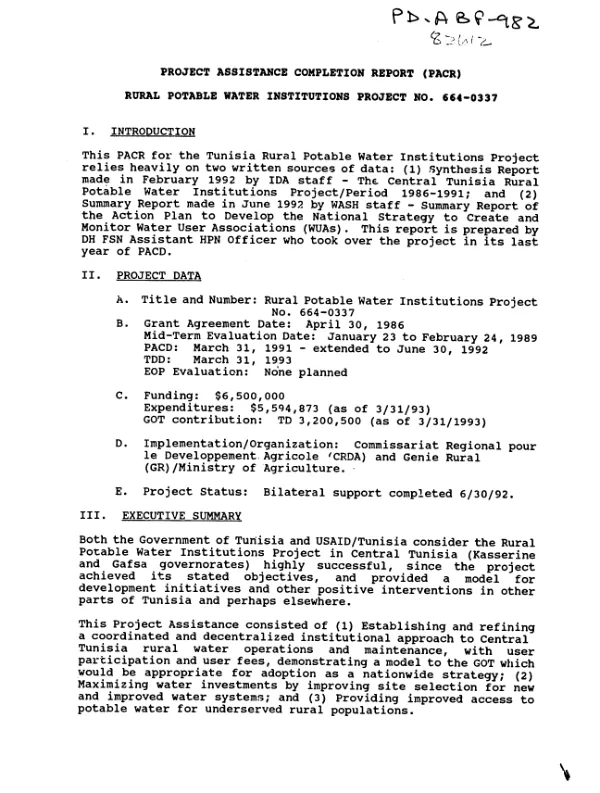
Designed to address problems that had plagued earlier rural potable water programs in Central Tunisia -- water point selection based on political criteria rather than need, waste of energy and water, a high frequency of water system breakdowns, and a lack of health education -- the project achieved its stated objectives, and its implementation mostly by indigenous personnel provides a model for future development interventions in Tunisia and elsewhere. The project succeeded in establishing a coordinated, decentralized institutional approach to rural water operations; it introduced a multi-disciplinary, equity-based site selection methodology and reduced water system operation inefficiencies by promoting community participation through water user associations (WUAs) and user fees. The WUAs became the focus for a variety of health education interventions and for increasing the role of women in decisionmaking. The project successfully completed all of its construction objectives, including the drilling of 30 new boreholes, extension of four existing potable water systems, and a pilot project of house connections in one community. The success of the project"s strategy confirms the importance of the social sciences in planning and implementing rural development, and in particular, the effectiveness of and need for community participation and local management of local water resources. The success of the WUAs in Central Tunisia has sparked interest at the national level, where the political and economic climate has moved toward greater decentralization. The agency responsible for most water systems in rural Tunisia, Genie Rural, is promoting a national strategy for the creation of WUAs and has instructed its governorate-level offices to organize communities to assume responsibility for water system operation and maintenance. In addition, another major donor active in Tunisia"s rural water sector, the German Kreditanstalt fuer Wiederaufbau (KfW), has adopted the WUA concept, and associations are being formed in communities where KfW-funded water systems are operating. WUAs now exist in all rural governorates of Tunisia and the Tunisian Government is committed to extending community management of local water resources to the entire country.
Related documents