USAID DEC
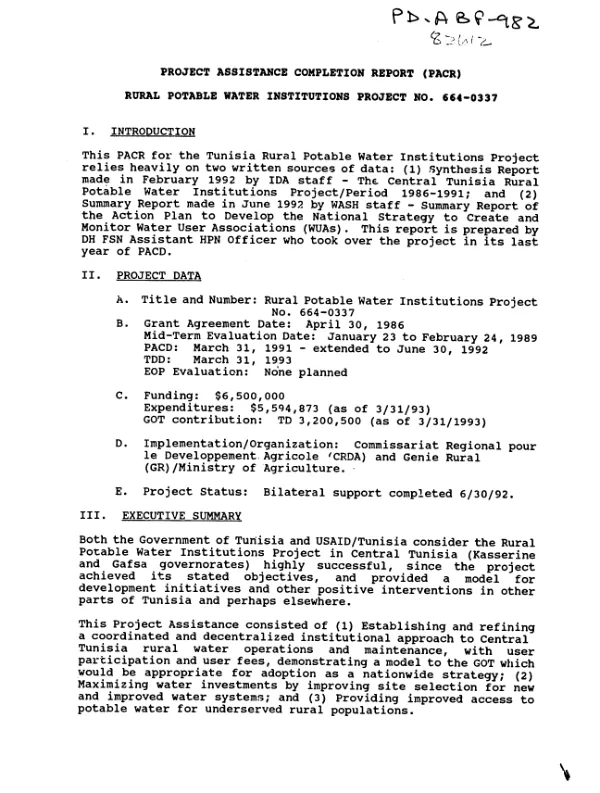
Synthesis report : the Central Tunisia rural potable water institutions project -- 1986-1991 (USAID project number 664-0337)
Sign inCLARK UNIVERSITY
Synthesis report : the Central Tunisia rural potable water institutions project -- 1986-1991 (USAID project number 664-0337)
Special evaluation of a project to establish a model decentralized approach to rural potable water operations and maintenance in Central Tunisia.
1992
Sign in to readA free account is required to download.
Abstract
Evaluation covers the period 1986-91. The Rural Potable Water Institutions (RPWI) project in Kasserine and Gafsa governorates is considered a success by both the Government of Tunisia and the USAID. Designed to address specific problems that had plagued earlier rural potable water programs in Central Tunisia, the project achieved its stated objectives and provides a model for future development interventions in Tunisia and elsewhere. The problems addressed included water point selection based on political criteria rather than on the basis of need, waste of both energy and water, a high frequency of water system breakdowns, and a lack of health education programs to ensure hygienic use of potable water. The RPWI project instituted an equity-based site selection methodology and reduced water system operation inefficiencies by promoting community participation through the creation of water user associations (WUAs). These associations also became the focus of a variety of health education interventions. The project visibly reveals the effectiveness of, and the need for, community participation and local management of local water resources. The project accomplishments demonstrate the central role that the social sciences should take in the design and implementation of rural development policy. Coinciding in the 1980s with a major shift toward political decentralization and economic liberalization in the overall context of Tunisian development, the project was executed by Tunisian engineers, social scientists, and health education specialists, committed to its community-participation focus. With some short-term expatriate assistance, these Tunisians made the RPWI project an impressive success, a development model that is rapidly being disseminated to other regions and development sectors throughout the country. (Author abstract)