USAID. MISSION TO ECUADOR
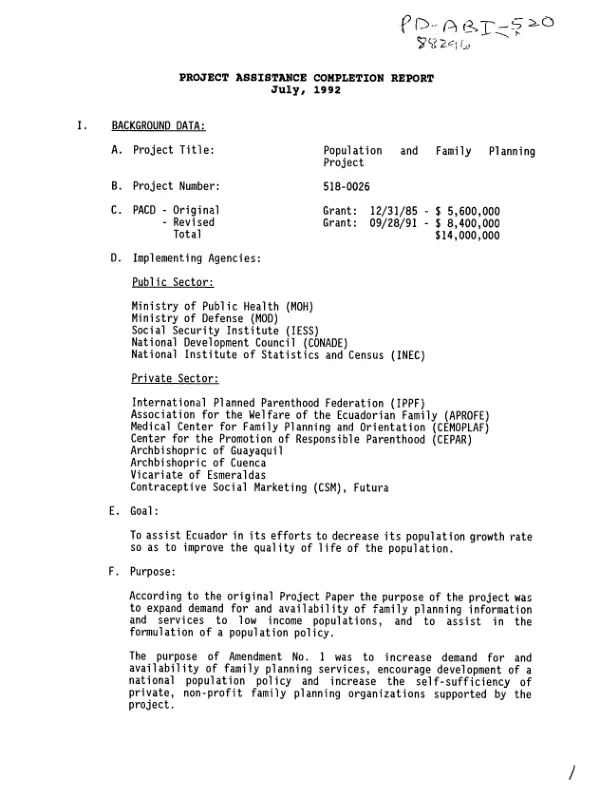
Project assistance completion report : population and family planning project
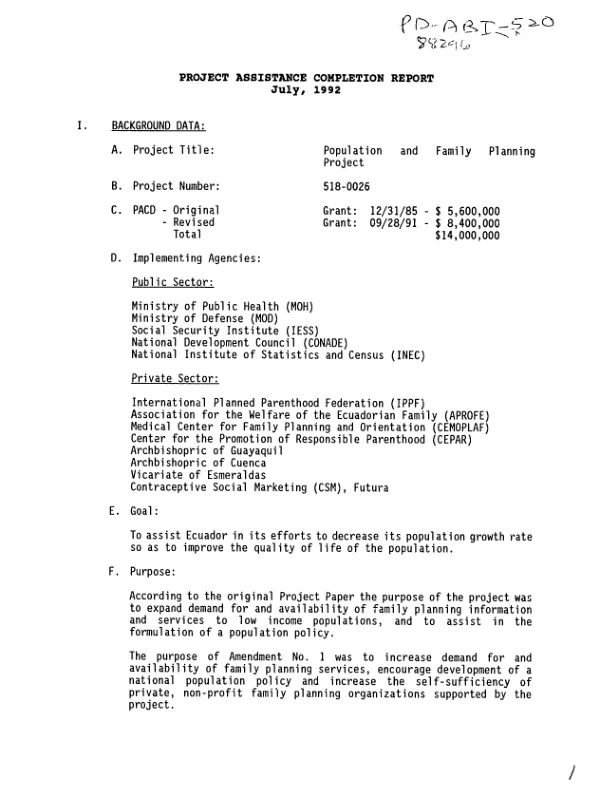
PACR of a project (4/81-9/91) to expand family planning (FP) information and services through in Ecuador"s public and private sectors.
1992
Sign in to readA free account is required to download.
Abstract
The project was a great success, exceeding its targets, and generated a follow-on (5180054), which is currently being implemented. Specific achievements included: a decrease in the crude birth rate to 29% (vs. a target of 35%) and an increase in the contraceptive prevalence rate to 54% (vs.48%); expansion of Association for the Welfare of the Ecuadorian Family (APROFE) clinics to 18 (vs. a target of 13) and of Medical Center for Family Planning and Orientation (CEMOPLAF) clinics to 20 (vs. a target of 6 clinics and 3 laboratories); and increase in APROFE and CEMOPLAF users to around 420,000 (vs. 351,000); an increase in FP outlets of the Campesino Social Security Program (SSC) to 547 (vs. 530); an increase in contraceptive distributors to 1,292 (vs. 1,240); and an increase in private doctors and midwives providing FP services to 74 (vs. 80). The Catholic Church participated in the project through grants to the Archbishopric of Cuenca and the Vicariate of Esmeraldas for projects in natural FP; and the Government of Ecuador published a population policy in October 1987, but unfortunately it has not been implemented. The Contraceptive Social Marketing Program created through Fundacion Futura, a local PVO, in conjunction with two private pharmaceutical firms, had two components: IEC and distribution. (1) Under the IEC component, a mass media campaign led by Fundacion Futura and the Center for the Promotion of Responsible Parenthood (CEPAR) promotes general FP on TV, specific methods on radio, and Protektor condoms on both. CEPAR, APROFE, and CEMOPLAF also produce FP publications, and CEPAR has prepared an average of 9 research studies a year, vs. a target of 12. In December 1990, the IEC Coordinating Committee, representing APROFE, CEMOPLAF, CEPAR, the Ecuadorian Social Security Institute (IESS), and Fundacion Futura, was officially established. (The Ministry of Health is not formally represented on the committee, but is invited to its meetings). Committee members have had the opportunity to work and study together, support each other, and preclude duplication of efforts by sharing experiences. (2) Results of the distribution component were mixed. Almost 2.5 million orals were distributed between 1988 and 1991, vs. a target of 680,000, but distribution of condoms did not begin until June 1991 and has totaled only about 10% of the annual target of 1 million. More generally, the project has changed an environment that was once indifferent or hostile to FP to one in which the discussion of FP is common. It has also enabled FP PVOs to gained prestige at the national and international levels. This 10-year project is part of A.I.D."s 25 years of FP service provision which has reduced Ecuador"s rate of population growth from 3.2% to 2.6% and the total fertility rate from 6.9% to 4.3%, and has increased the country"s contraceptive prevalence rate from 13% to 54%. With the culmination of this project, it can be said that FP as a concept is fully established in Ecuador, making it highly improbable that serious regressions will occur.