USAID. MISSION TO ECUADOR
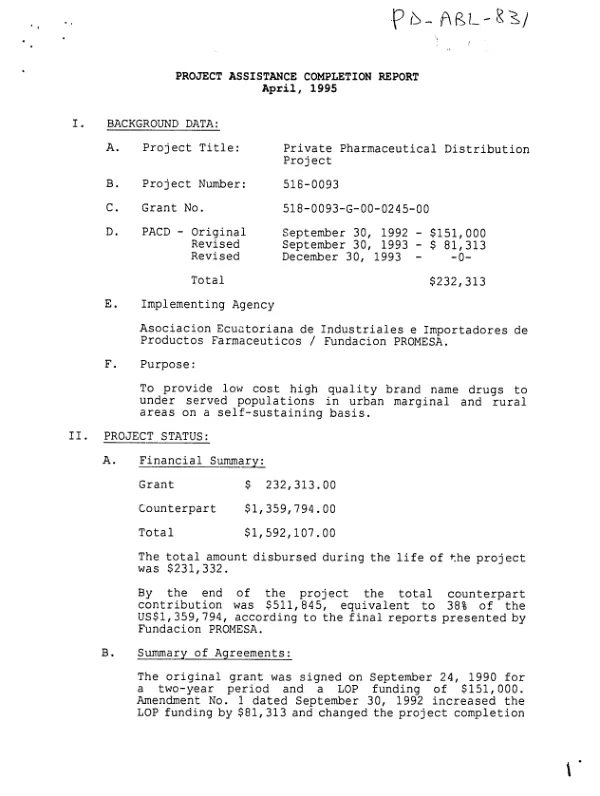
Project assistance completion report : private pharmaceutical distribution
PACR of a project (9/90-12/93) to provide low-cost essential drugs to underserved populations in marginal urban and rural areas in Ecuador on a self-sustaining basis.
1995
Sign in to readA free account is required to download.
Abstract
The project was implemented by Asociacion Ecuatoriana de Industriales e Importadores de Productos Farmaceuticals/Fundacion PROMESA, which in turn signed agreements with local NGOs to establish botiquines (dispensaries) in low-income areas lacking access to a private pharmacy. PROMESA was responsible for training all botiquine administrators and NGO staff. By the end of the project, 182 botiquines (vs. 60 targeted) had been established in 16 provinces. The drugs, which were only dispensed if prescribed by the dispensary physician, were sold at an average price of 42% lower than the public commercial price. More than 80% of participating pharmaceutical laboratories offered a 30-day grace period for payment and the remaining labs provided credit for up to 60 days. With the expansion of the grant in 9/92, increased emphasis was placed in education through art and communication activities; a guide for NGOs planning to use the education through art strategy was developed and disseminated. In January 1994, Fundacion Eugenio Espejo, a local NGO with extensive experience in this field, submitted a draft final evaluation of the project. The evaluation, which found the results of the project to be mixed, begins by assuming that PROMESA always had a hidden agenda to expand the market share of the pharmaceutical industry; it also implies that the beneficiary NGOs are not necessarily acting in the best interest of the community, since the profit margin of the botiquines is substantial. PROMESA has provided a rebuttal to the draft evaluation. To fully establish the successes and limitations of the project, yet another evaluation would be needed, something which is precluded by the Mission"s financial and personnel limitations. Nonetheless, whatever the shortcomings of the evaluation, field visits by the USAID Project Officer and interviews with beneficiary organizations clearly demonstrate the feasibility of a pharmaceutical distribution network which relies on the private sector to provide essential medications at a low cost to underserved populations. Further, PROMESA, which has taken on the role of an "umbrella" NGO, has provided TA and support which have considerably strengthened the administrative and financial capacity of a large number of NGOs, which are running their organizations as micro-enterprises. The project required relatively little USAID input in terms of financial support and management effort. Moreover, pharmaceutical industry interest has been strong, and a large number of NGOs have benefited significantly in terms of administrative and financial skills. Lessons learned include the following. (1) This project demonstrates that there is no conflict between the private provision of goods and services and the goal of reaching targeted populations. (2) Well-trained and motivated employees in pharmacies can change the medication habits of a community. In a country where there is significant overmedication and self-medication, it is important not to provide medication without a prescription. (3) Training NGOs in administrative and financial management has a definite payoff in terms of improving not only their operations, but also their ability to better negotiate terms with private providers. Many of the NGOs have graduated from PROMESA and are negotiating discounted prices directly with the pharmaceutical companies.