USAID. MISSION TO EL SALVADOR
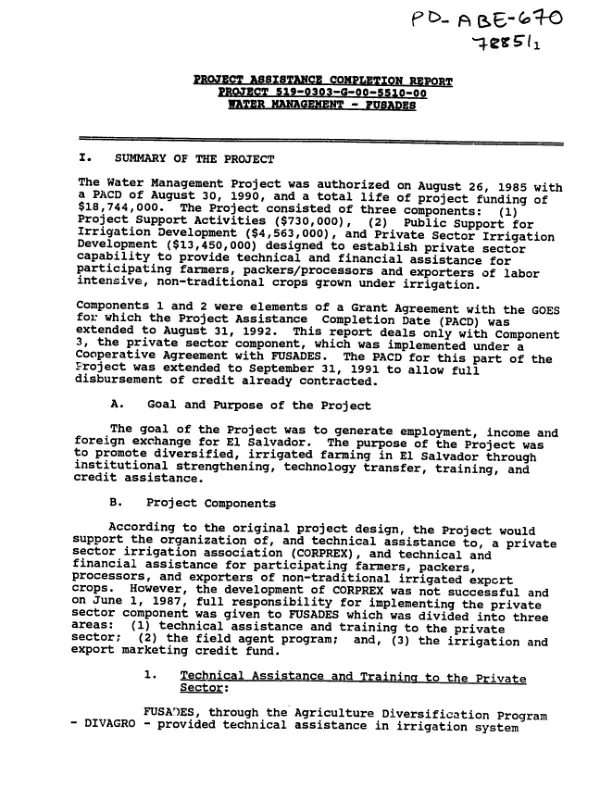
Water management
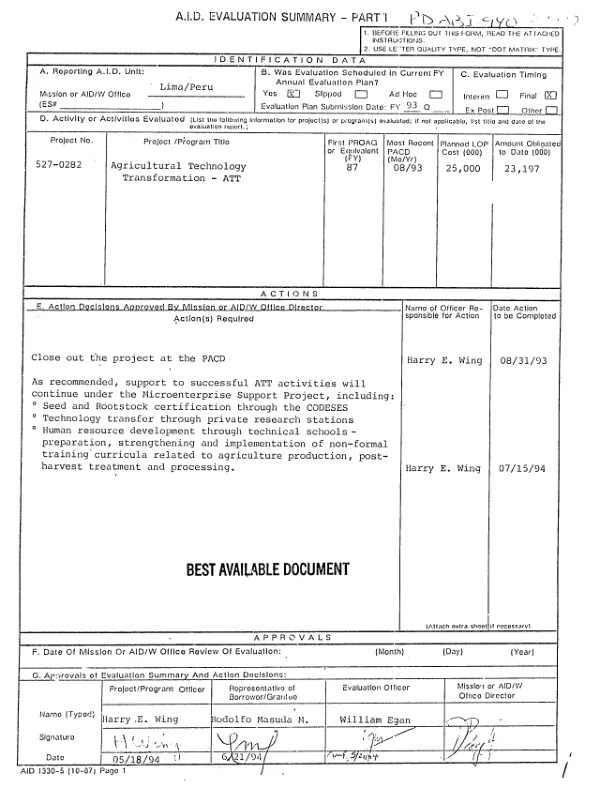
Summarizes final evaluation (XD-ABD-288-A) of a project to promote diversified irrigated farming in El Salvador through institutional strengthening, technology transfer, training, and credit assistance to both public and private sector agencies.
1991
Sign in to readA free account is required to download.
Abstract
The evaluation covered the period FY85-6/90. Progress has accelerated in almost every aspect of the project since the first evaluation, due primarily to the arrival and productivity of long-term TA personnel and a noticeably better political climate since the Cristiani government took office. The six participating public sector institutions established a coordinating unit which meets weekly to guide project activities. The unit has coordinated: a process for producing annual inter- agency work plans; a diagnosis of water use in the agricultural sector; an evaluation of all water use laws and a proposal for a new water use policy and law; a data bank to monitor progress and improve planning; and training and TA plans for technicians and farmers. There has been a marked improvement in the technical capacity of the staff at the public institutions, and it is expected that training goals for the public sector will be surpassed. The private sector, through the Salvadoran Foundation for Economic and Social Development (FUSADES), has also made strides since the last evaluation. Loans approvals increased from 5 to 12 for irrigation equipment and from 3 to 25 for processing facilities. The total loan portfolio is now nearly $9 million. DIVAGRO, FUSADES" research and extension arm, has partially funded 41 field agents working for processors and farmers, and its data bank and library are the best in the country for irrigated agriculture. Despite impressive quantifiable increases in short-term training, some problems exist in terms of training quality. These include: a scarcity of written course material and information on course content, a lack of attention to areas other than irrigation that influence production, and the need for further analysis of the economics of irrigated agricultural production. There is also a need to develop an information transfer strategy. Additional constraints to project progress include: recurring administrative problems, continued political disturbances which erode confidence in rural investment, and a continued lack of coordination between public and private activities. A major lesson learned is the necessity of clear lines of authority and coordination between public and private sector entities before projects of this type are started. Another lesson is that technology transfer is a slow process requiring access to the best available worldwide knowledge of production and marketing. Action decisions are to extend the PACD for the public sector component 2 years to 8/30/92 and for the private sector component 6 months to 3/31/92.
![Project assistance completion report : project USAID no. 519-0303 -- water management-GOES [Gobierno de El Salvador]](https://covers.devme.ai/gen/6459.webp)
![Project assistance completion report : project USAID no. 519-0303 -- water management-GOES [Gobierno de El Salvador]](https://covers.devme.ai/gen/75206.webp)