USAID DEC
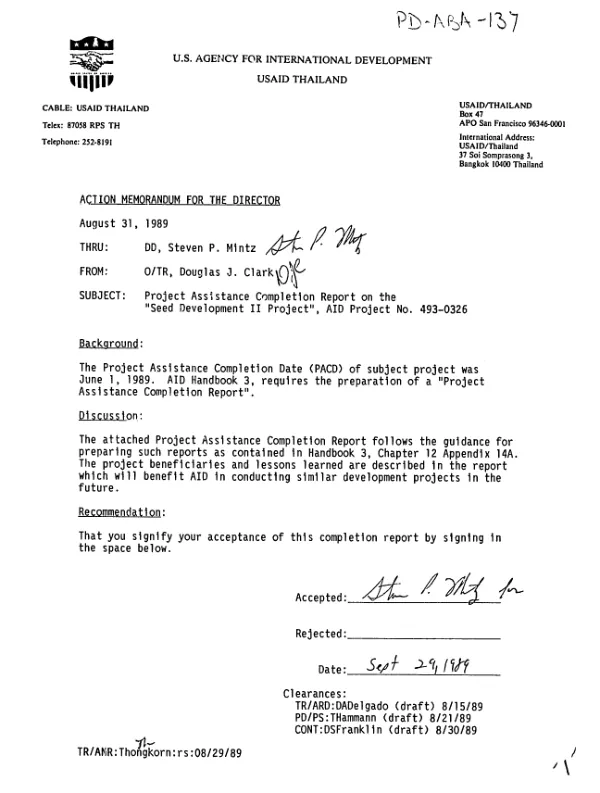
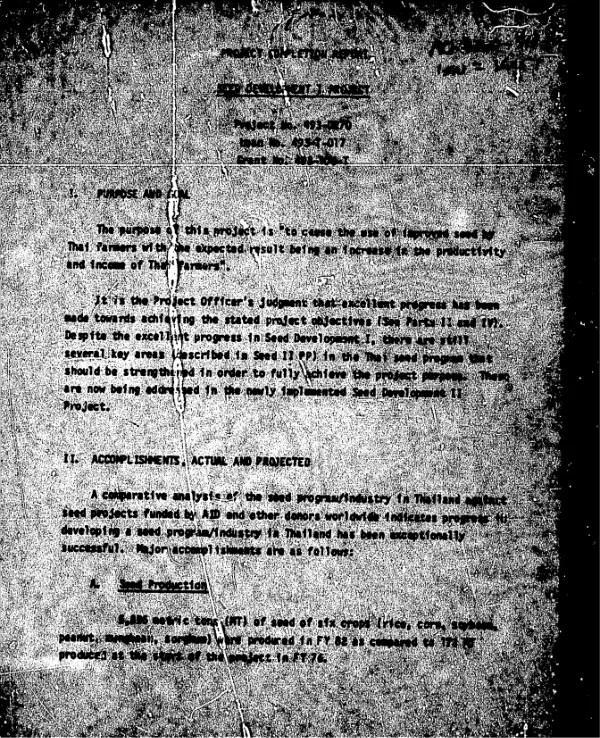
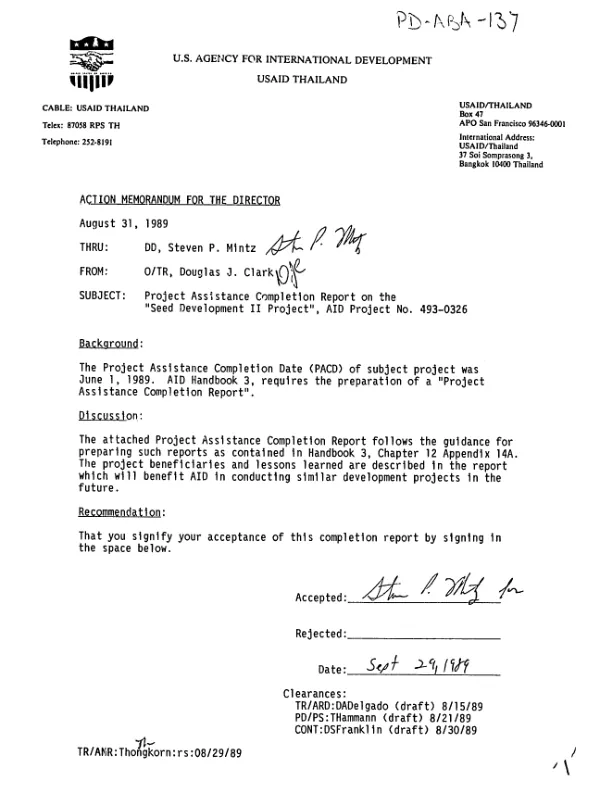
Project assistance completion report : seed development II project, project no. 493-0326, loan no. 493-T-027
Sign inUSAID. MISSION TO THAILAND
Project assistance completion report : seed development II project, project no. 493-0326, loan no. 493-T-027
PACR of a project (4/82-7/89) implemented by Mississippi State University (MSU) to improve the access of Thai farmers to high-quality seed by strengthening the Department of Agricultural Extension (DOAE) Seed Division (SD) and its seed centers; supporting seed development, promotion, and marketing; and encouraging private sector involvement in the seed industry.
1989
Sign in to readA free account is required to download.
Abstract
The project was successful and its results should be long-lasting. The SD expanded from 4 centers under project 4930270 in 1978 to 20 centers by the end of the present project. Twenty SD staff members received M.S. training in seed technology, agricultural management, and agricultural economics and are now working at seed centers throughout the country. Informal seed clubs or associations were established, helping foster relationships between the public and private sectors. Seed production increased from 165 mt in 1976 to 21,700 mt in 1987 (a 13,000% increase), but this amount was only 5.6% of the total demand of 388,687 mt. Farmer demand for certified seed grew markedly every year, while the SD was able to increase its production just 2,000 mt annually. Nevertheless, because the project did intensify farmer demand for improved seed, several private businesses were prompted to establish operations in Thailand's seed market. In particular, Cargill International, Pacific Seeds, Pioneer, and Bangkok Hybrid Seeds moved into maize seed production during the project period. The project's success was due primarily to the MSU and SD administration and support staff. They provided good leadership, were flexible and cooperative, and had specific, realistic goals. Further, seed centers flourished because of their small-size and strategic location, which facilitated efficient operations and maintenance, minimum transport costs, and the ability to meet local seed needs. Continuous staff training and upgrading was also a key element of project success. Lessons learned include the following. (1) Decentralized seed facilities expand the seed production area at minimum cost and help promote the use of improved seed as farmers see firsthand its production. (2) For U.S. university staff to be productive and able to devote long periods of time away from their school, the university administration must be willing to advance the staff along normal career paths, as MSU did in this instance. (3) MSU's decision to specialize in a limited development agenda, i.e., seed development, was a sound idea.