USAID. MISSION TO THAILAND
Project completion report : seed development I project
Provides final Mission report (1976-82) on a project to increase production by Thai farmers by encouraging the use of improved seed.
1979
Sign in to readA free account is required to download.
Abstract
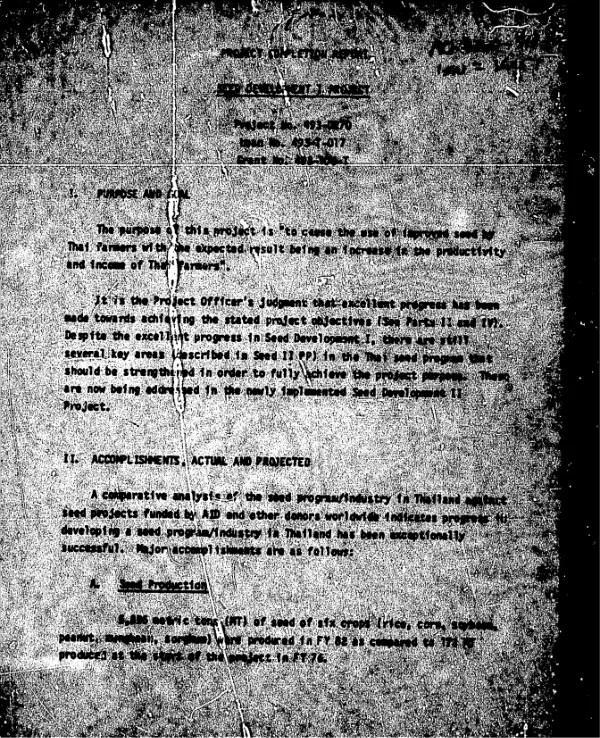
Despite an unrealistic design, the project was exceptionally successful in achieving its objectives. Production of seed for six crops (rice, corn, soybean, peanut, mungbean, sorghum) increased from 173 MT in FY 1976 to 5,896 MT in FY 1982. Increases in direct counter sales at the Seed Centers and farmers' willingness to travel great distances to obtain improved seed indicate that farmer demand for most varieties of project seed is strong. In addition, 3,600 contract farm families are currently receiving assistance in seed production, up from the 200 contract farm families organized at the start of the project. A Seed Division (SD) with a technically competent staff of 250 (helped by the project's provision of M.Sc. training to 6 persons and 3-month training of 8 others in the United States) was created within the Department of Agricultural Extension to manage Thai Government (RTG) seed activities and to promote the national seed industry; the major project role envisioned for the Marketing Organization for Farmers never materialized. In line with a stated project objective, 60% of all seed produced by the SD is used to support RTG emergency assistance projects (the rest is sold outright to small farmers). Modern seed processing centers were established at Chainat, Korat, Phitsanulok, and Lampang, emphasizing production of the six crops mentioned above. Production of rhizobium inoculant rose from 3 tons annually in 1976 to over 20 tons at the project's close, although demand is still substantially below production capacity. Despite the project's successes, which have spurred interest by other donors, problem areas have had to be addressed by the follow-on project - ineffective marketing and distribution of processed seed, underpicing of seed, and the too rapid expansion of the seed program. Lessons learned are: delays should be expected when loan projects require host country procurement of TA and equipment; small farmers can be successfully trained as contract growers to produce quality seed; establishment of a seed program/industry is a long-term process; and public sector seed programs can act as a catalyst for private sector involvement.
Related documents