USAID DEC
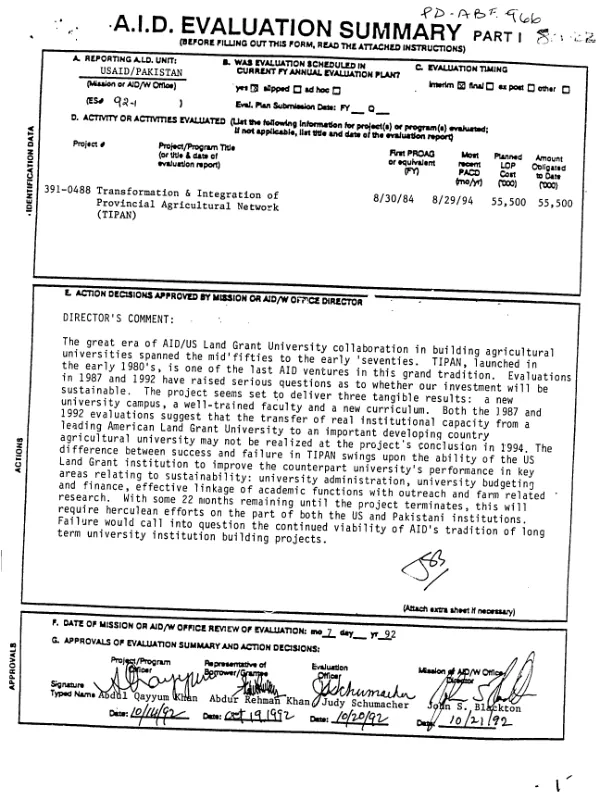
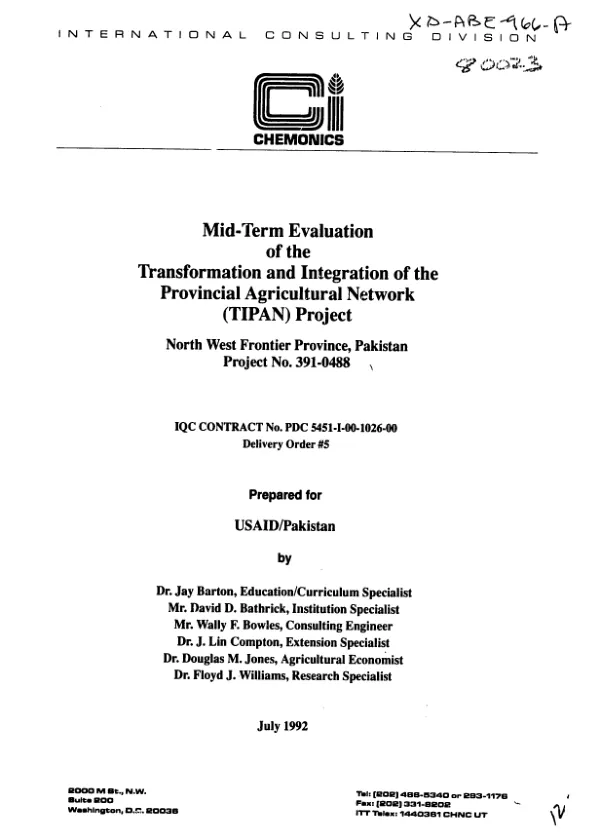
Project assistance completion report : transformation and integration of provincial agricultural network (TIPAN) (391-0488)
Sign inUSAID. MISSION TO PAKISTAN
Project assistance completion report : transformation and integration of provincial agricultural network (TIPAN) (391-0488)
PACR on a project (8/84-8/94) to modernize agricultural research and extension in Pakistan's Northwest Frontier Province (NWFP) by upgrading curricula, research, and outreach at the Agricultural University at Peshawar (AU).
1994
Sign in to readA free account is required to download.
Abstract
AU has made excellent progress in improving educational quality, and more limited progress in the areas of research system integration, agricultural outreach, and organizational development. AU established a Directorate of Teaching; reformed its admission policy, which now reserves seats for members of various ethnic, geographic, and social groups, and women; converted its old external examination system into a two-term system with an internal examination and a grade point average system; and improved curricula, which now meet international standards and include math, science, entrepreneurship, and English courses. AU also developed a Learning Resource Center and established a placement office for students. One hundred and thirty faculty and research staff received degree training. Moreover, cheating during exams, a common problem in Pakistani universities, has been completely eliminated at AU. AU will have to resist the urge to inflate the performance of its students -- a practice common among Pakistani universities trying to help students to compete for a common pool of federal jobs -- if it is to establish a reputation as a quality educational institution. Integration of NWFP's research system under the aegis of AU was incomplete. While the research system's budget, physical facilities, and staff were transferred to AU, an amendment to the merger act -- lobbied for by research staff who feared their professional opportunities would be limited if they were drawn under AU's wing -- allowed research staff to remain under the control of the provincial civil service. While this situation was resisted by the first 3 Vice Chancellors, the fourth has yielded to the Provincial Agriculture Department (PAD), which now handles all research staff transfers. While the incomplete merger has constrained research progress, improvements have been made to the extent possible through personnel development, provision of laboratory equipment, and development of a Master Research Plan. Research highlights include the discovery that oats produce 3 times as much fodder as wheat, and a study of the use of various herbicides on wild oats. Despite lack of commitment by AU administrators to the concept of outreach, AU did establish an Outreach Directorate, comprised of outreach, a communications services center, and a Division of Continuing Education, which is gradually being accepted both at AU and by provincial leaders. Efforts have included a variety of training for farmers, extension agents, field assistants, and women. A continuing constraint stems the exclusion of the Provincial Agricultural Extension Service from the merger with AU. There have also been other difficulties in integrating teaching, research, and outreach functions, as the plan to give faculty and research staff split-assignments has been accepted by very few faculty. As for organizational development, many planned administrative reforms never took place at all, including decentralization of administration, development of a unified personnel system, merit- rather than seniority-based promotion, and planning for sustainability. Networking was more successful. AU strengthened linkages with Faisalabad and Tandojam, Gomal, and Barani Agricultural Universities; has firm working relationships with the Pakistan Agricultural Research Council (PARC) and the National Agricultural Research Center (NARC); and has established linkages with U.S. universities and international research centers such as CIMMYT and ICARDA. Finally, the project funded the construction of 13 major academic buildings and 11 small farm center buildings and related infrastructure. The following lessons were learned. (1) AU should pursue efforts to integrate its agricultural education, research, and extension programs with those of the PAD. (2) Construction of the AU campus could have been more economical through the use of local contractors, and should have been implemented in multiple phases rather than as a single large project. (3) Development, on the pattern of the U.S. Land Grant System, of a sustainable institution which will have impact on the economic life of the rural poor takes perhaps 15-20 years. In the case of the AU, the early termination of TA (after 10 years) may jeopardize the huge investment already made.
Related documents
Documents in this collection
 1994
1994USAID DEC
Project assistance completion report : transformation and integration of provincial agricultural network (TIPAN) (391-0488)
Open record![Project assistance completion report : UAF/GRTSM [University of Agriculture, Faisalabad/Grain Research, Training and Storage Management (Cell)] project activities, July - August, 1994](https://covers.devme.ai/gen/7043.webp) 1994
1994USAID DEC