USAID DEC
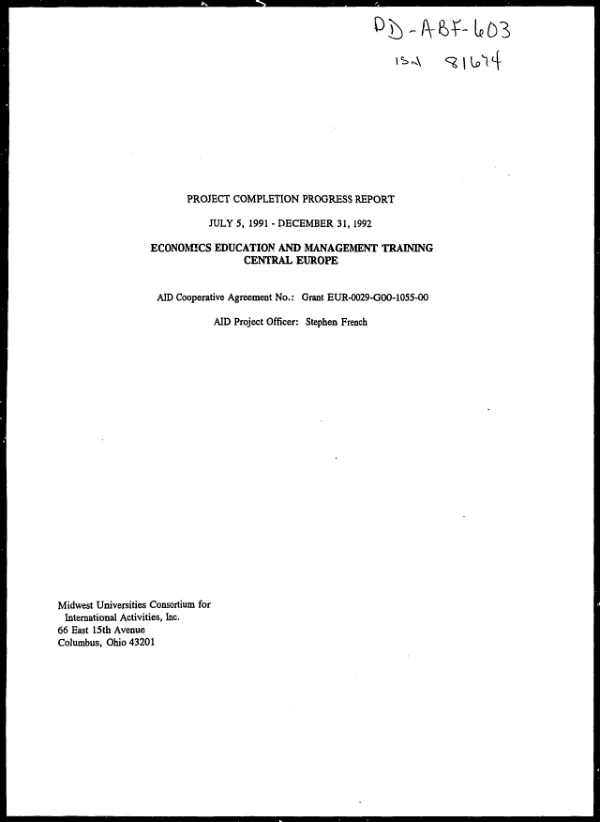
Project completion progress report : July 5, 1991-December 31, 1992 -- economics education and management training, Central Europe
Sign inMIDWEST UNIVERSITIES CONSORTIUM FOR INTERNATIONAL ACTIVITIES, INC. (MUCIA)
Project completion progress report : July 5, 1991-December 31, 1992 -- economics education and management training, Central Europe
The purpose of this report is to provide qualitative and quantitative information on the completion of year one activities of the Management Training and Economics Education for Central Europe (MTC) project which is being implemented by Midwest Universities Consortium for International Activities (MUCIA).
French, Stephen · 1992
Sign in to readA free account is required to download.
Abstract
The report includes a summary of the project, its goals and objectives; MUCIA"s approach -- what was developed, how it was organized and delivered; a general discussion of achievements, project outcomes, and lessons learned; and planned next steps and a conclusion. The goals and objectives of the project as proposed by MUCIA in 1991 were to assist the Czech Republic, Hungary, and Poland in their transition to a market economy and to build high-quality management education capabilities within existing institutions of higher education. MUCIA"s challenge was to address the root of the problem faced by each country by developing the management talent that could make possible the transition to a market economy. It did this by offering a short-term solution with a long-term impact: educating a new generation of business managers to facilitate the economic transition within each country while simultaneously training a new generation of educators to ensure a national capability to develop the future management talent necessary in a market economy. The MUCIA strategy is sustainable; it builds institutional capabilities to support management education within each country and a cadre of management educators emphasizing practical business applications, and it fosters national and international networking among faculty and managers alike. The strategy was developed to be cost effective -- it successfully adapted management education materials to the local context, it emphasized in-country management of program operations, and it built on existing business education prototype activities between MUCIA and each country. In summary, teams of MUCIA faculty organized and delivered executive education programs in the Czech Republic, Hungary, and Poland for managers within the first year. In addition, each activity of this project, including executive education training for counterpart faculty, case methodology workshops, and the Professional Managers Program, was designed to develop the abilities of Central European faculty and their host institutions to provide the critically needed management training programs to service their national economies. Now that cooperation has been established between a number of U.S. and Central European faculty, additional assistance and consultation can be carried on through faculty exchange and joint research programs. (Author abstract)
Related documents
Documents in this collection
 1991
1991USAID DEC
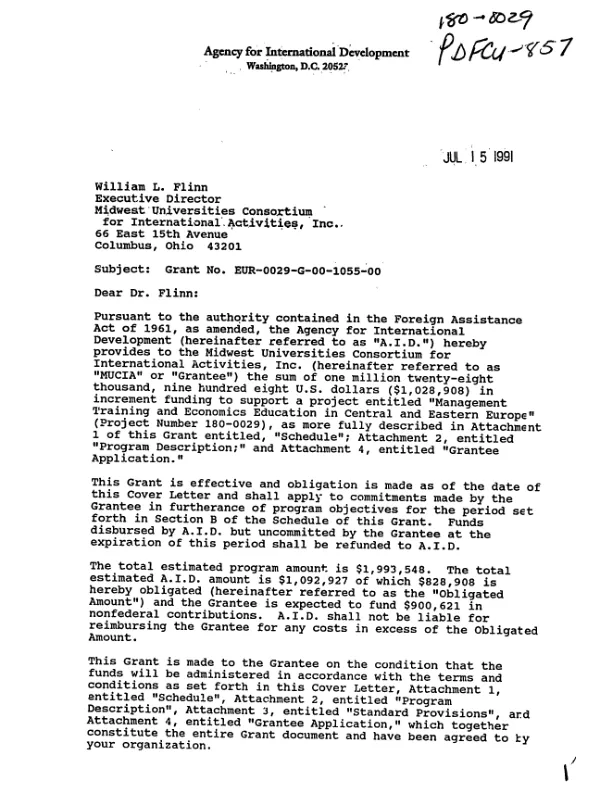
AID grant no. EUR-0029-G-00-1055-00 to the Midwest Universities Consortium for International Activities, Inc. for support under the management training and economics education program
Open record 1999
1999USAID DEC
![Environmental training project : annual report for year II, February 10, 1993-February 11, 1994 -- cooperative agreement number EUR-00410A-00-2020 [i.e. EUR-0041-A-00-2020]](https://covers.devme.ai/gen/33271.webp)