USAID DEC
Project Development and Financing for Renewable Energy Projects
Project development involves a series of stages to determine project viability and secure funding.
2016 · 2 pages
Sign in to readA free account is required to download.
Abstract
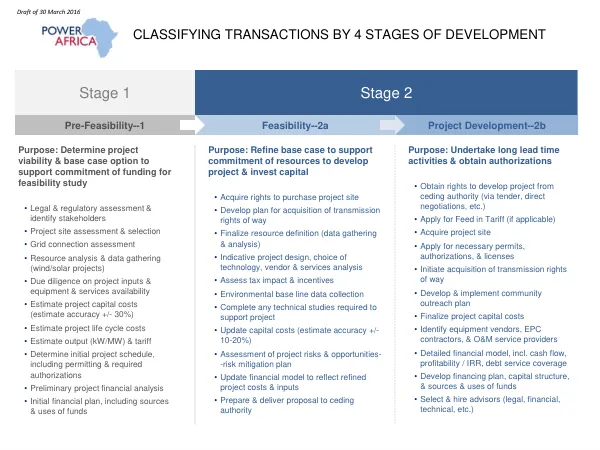
The pre-feasibility stage assesses the project's potential and identifies key stakeholders, project sites, and resource availability. This stage includes a legal and regulatory assessment, project site selection, grid connection assessment, and resource analysis. Due diligence is conducted on project inputs, equipment, and services, and estimates are made for project capital costs, life cycle costs, and output. The pre-feasibility stage also involves preliminary financial analysis and the development of an initial financial plan, including sources and uses of funds. This stage is critical in determining the project's viability and identifying potential risks and opportunities. The results of the pre-feasibility stage inform the development of a base case option, which is used to support the commitment of funding for a feasibility study. The feasibility stage refines the base case option and provides a more detailed analysis of the project's potential. This stage involves acquiring rights to purchase the project site, developing a plan for the acquisition of transmission rights of way, and finalizing resource definition. Indicative project design, choice of technology, and vendor and services analysis are also conducted during this stage. The feasibility stage also assesses tax impact and incentives, collects environmental baseline data, and completes any technical studies required to support the project. The feasibility stage updates capital costs and financial models to reflect refined project costs and inputs. It also assesses project risks and opportunities and develops a risk mitigation plan. The results of the feasibility stage are used to support the commitment of resources to develop the project and invest capital. The project is then classified into one of four stages of development: pre-feasibility, feasibility, project structuring, or project financing. Project structuring involves the development of a project vehicle, negotiation of power purchase agreements, and the identification of lenders and equity providers. This stage also involves the development of a preliminary information memorandum to attract financing and the preparation of an environmental and social impact assessment. The project structuring stage is critical in arranging finance on terms and conditions sufficient to execute all project agreements. Project financing involves the confirmation of lenders, agreement of a financing plan with lenders, and the development of a lender financial model. Lender due diligence on the project is conducted, and term sheets are finalized with lenders. Credit enhancement mechanisms and lender security packages are also finalized during this stage. The project financing stage is critical in securing the necessary funding to execute the project. The project completion stage involves the commencement of construction and the reach of commercial operations date. This stage includes the issue of a notice to proceed, the procurement of equipment, and the completion of construction. A shake-down period is also conducted to test and adjust the project's performance before being declared operational. The project completion stage is critical in meeting all completion tests and commencing power delivery and sales. The project completion stage also involves reaching financial close, which includes the completion of architectural renderings, logistical site plans, and permitting. Equipment suppliers, EPC contractors, and O&M firms are selected, and all conditions precedent to reach financial close are met. The project completion stage is critical in securing the necessary funding to complete the project and reach commercial operations.
Related documents