USAID DEC
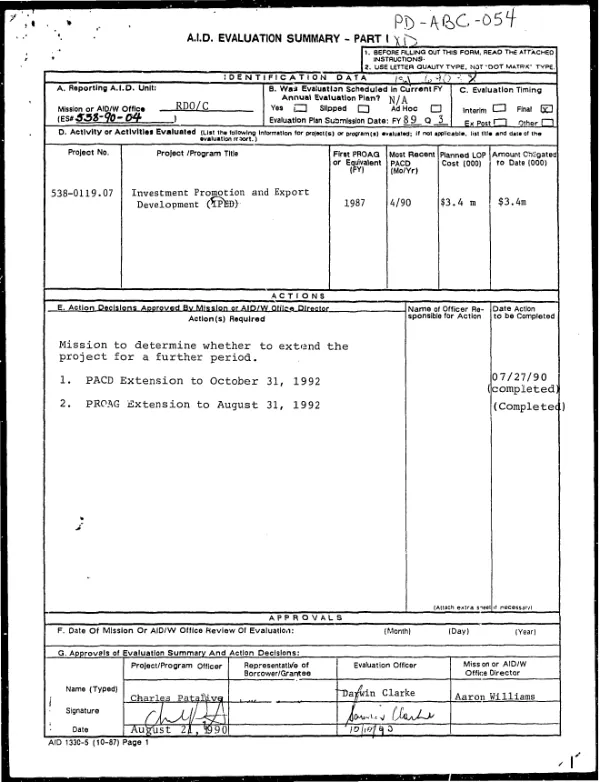
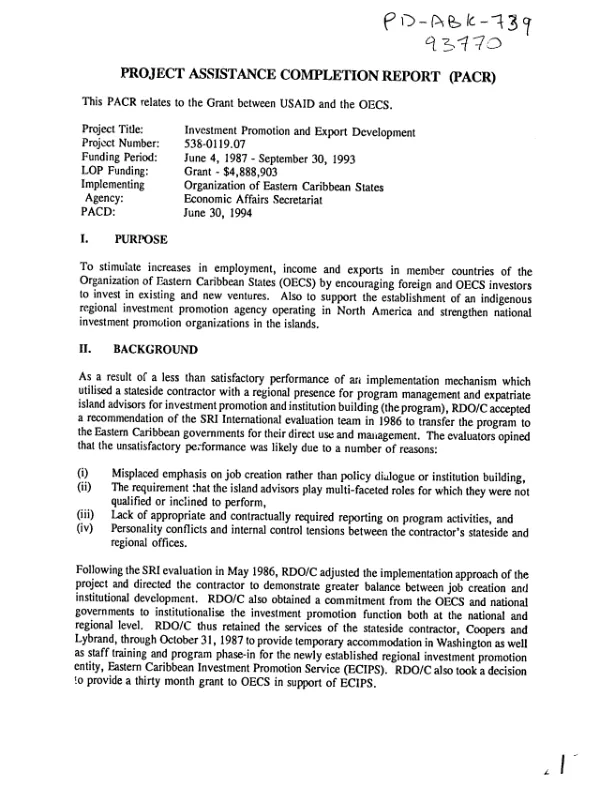
Project development assistance program (PDAP) - investment promotion and export development project
Sign inUSAID. BUR. FOR LATIN AMERICA AND THE CARIBBEAN. REGIONAL DEVELOPMENT OFC.
Project development assistance program (PDAP) - investment promotion and export development project
Summarizes attached final evaluation (XD-KAL-940-A) of the Project Development Assistance Program (PDAP) in the Eastern Caribbean (EC).
1988
Sign in to readA free account is required to download.
Abstract
External evaluation covered the period 1981-1987 and was based on document review, site visits, and interviews with project personnel and beneficiaries. The original purpose of PDAP, which was implemented by Coopers and Lybrand (C&L), was to help EC governments and the private sector design and implement employment-generating development projects. Emphasis was later placed on investment promotion (PDAP II) and then institutional development (PDAP III, which has now received a 1-year extension). Results were mixed. Noteworthy, though not quantifiable, achievements were made in improving investment climate, institution building, advising A.I.D. and host countries, and regional cooperation. PDAP promoted 50 investments, leading to 2,782 full-time jobs and net annual export earnings of $12.4 million. However, C&L and RDO/C took no steps early on to ensure sustainability. Further, C&L"s Washington Office spent much time and money early on in diffuse investor search efforts which yielded little, although these efforts improved markedly with experience. Country advisors should have paid greater attention to building host countries" investment promotion capabilities rather than to actual investment promotion efforts, and the latter should have been more oriented to training and demonstration. Finally, targets were unrealistic and were either skewed towards job creation - thus again diverting attention from institution building goals - or insufficiently quantified. Several lessons were learned. (1) PDAP was most successful in countries already oriented to foreign investment. (2) Project reports should be monitored and independently verified when quantitative results are important in project and contractor assessments. (3) The size and location of EC countries makes a strategy of identifying market niches capable of being filled by small and flexible manufacturing and subcontracting operations most suitable at present. (4) The geographical features of the EC archipelago escalated project costs to several times those of a project serving a population of a similar size on a single landmass. (5) Neither the Mission nor the contractor can abdicate responsibility for project costs and development outputs. (6) Investment projects that promise big results should be closely scrutinized. (7) Lessons regarding the need for careful monitoring and for early attention to sustainability should be applied to the EC Investment Promotion Service, being established under PDAP III. In sum, although investment promotion projects are likely to have only modest impact in attracting investors, this project has been successful enough to warrant RDO/C support for other projects of this type.
Related documents