USAID. BUR. FOR SCIENCE AND TECHNOLOGY. OFC. OF HEALTH
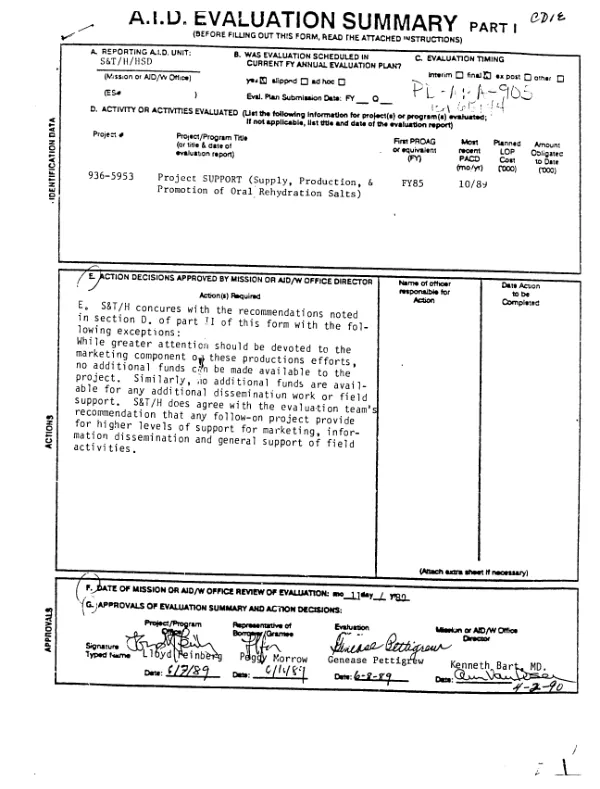
Project SUPPORT (supply, production, and promotion of oral rehydration salts)
Summarizes final evaluation (unattached) of a project implemented by the Program for Appropriate Technology in Health (PATH) to foster private sector production and marketing of oral rehydration salts (ORS) in developing countries.
1990
Sign in to readA free account is required to download.
Abstract
External evaluation covered 8/85-10/89. Results were mixed. PATH reached most of its production objectives, with local production capacity most advanced in Ghana, Guatemala, Paraguay, Peru, and Turkey, and more than 12 sites participating to some degree. Financing of production equipment worked well using an innovative and flexible A.I.D. loan fund. PATH also provided valuable TA to A.I.D. during a period of intense debate concerning the proper arrangements for controlling ORS quality. In part, this debate was a result of the sad deaths of several children in Peru in 1986 from over-concentrated doses of ORS, which had been manufactured by a U.S. firm and imported by USAID/P. Project implementation was impeded, however, by two factors which were not sufficiently allowed for in the project design. (1) ORS packets are physically and chemically more complex to produce than one might expect. existing local drug firms would be capable of marketing ORS without training and consultant support. As a result, no written marketing strategies were prepared for Guatemala and Ghana, and the business plan for the latter stressed production to the near exclusion of financing and marketing factors. There were also negative factors outside PATH"s control, e.g., complex host country bureaucratic and business procedures. Also, it proved extremely difficult to end free ORS giveaways by host governments and to avoid pricing conflicts between public and private ORS systems. In several cases, local ORS producers experienced serious cash-flow problems soon after product launch due to price regulation, low sales volume, and host government promotion of public sector programs. Several lessons were learned. (1) Assessments and business plans must cover the areas of production, marketing, financing, staffing, and facilities in depth. Nonetheless, it is extremely difficult, if not impossible, for a project to ensure for the local producer a stable market for ORS and sufficient freedom from government interference. (2) Production of ORS requires careful attention to international Good Manufacturing Practices and worker training in quality control. (3) The potential exists for local production of other health products, e.g., AIDS diagnostic kits. (4) Suspicion between public and private sector vis-a-vis the motives for local ORS production must be addressed. Given the nature of ORS as a social good, policy dialogue with national health and business leaders is critical to project sustainability.
Related documents
Documents in this collection
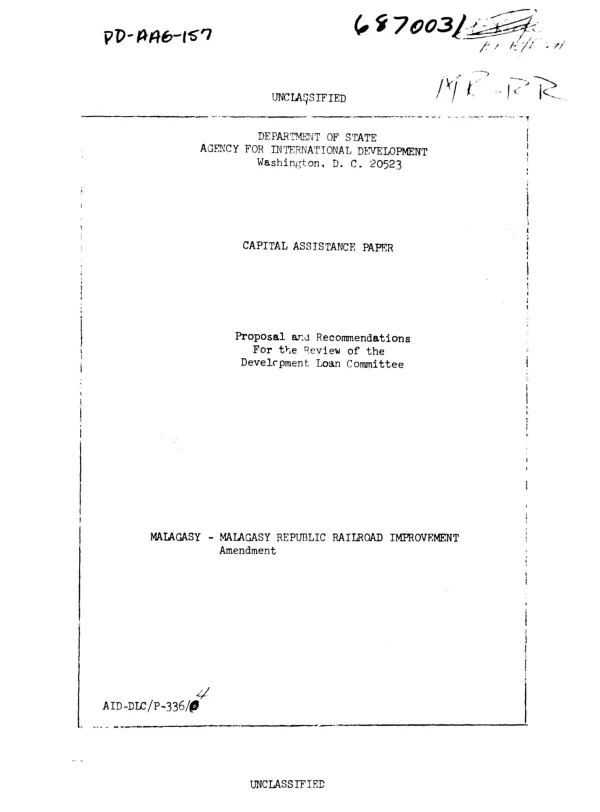 1996
1996USAID DEC
Project assistance completion report : LAPROMED component of project no. 520-0339, immunization and oral rehydration therapy (ORT) for child survival -- contract no. 520-0339-C-00-2234 with PATH
Open record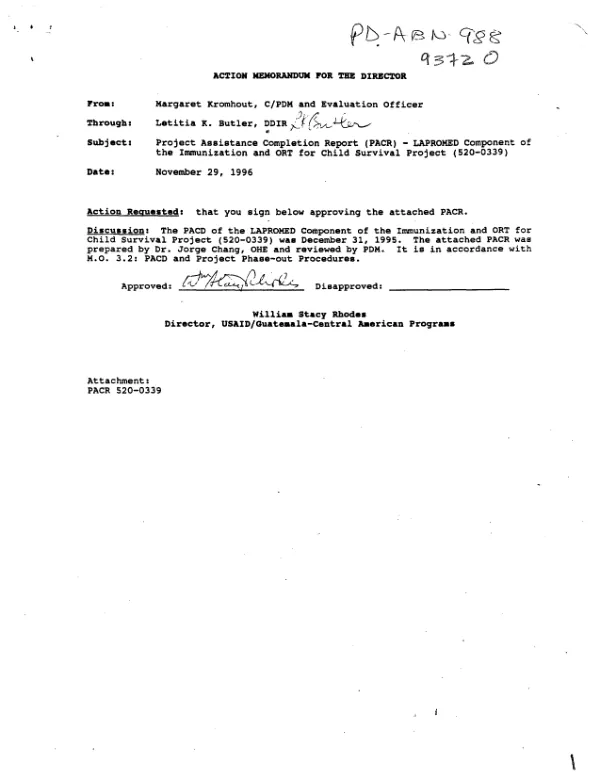 1996
1996USAID DEC