USAID DEC
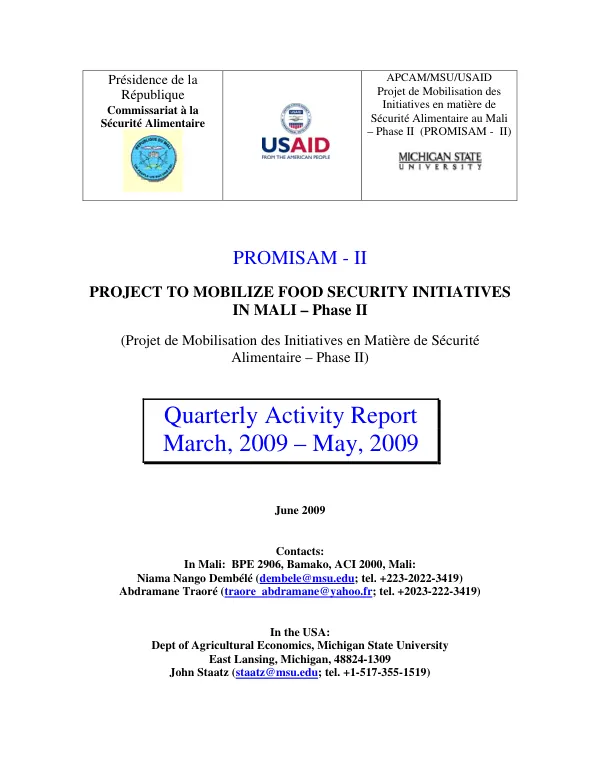
Project to Mobilize Food Security Initiatives in Mali – Phase II (Projet de Mobilisation des Initiatives en Matière de Sécurité Alimentaire – Phase II)
Sign inINTERNATIONAL PEACE CORPS
Project to Mobilize Food Security Initiatives in Mali – Phase II (Projet de Mobilisation des Initiatives en Matière de Sécurité Alimentaire – Phase II)
Strengthening the Capacity of the Malian Government to Develop Analytical and Market-Based Food Security Responses The second phase of PROMISAM, a project to mobilize food security initiatives in Mali, has four objectives.
2009 · 8 pages
Sign in to readA free account is required to download.
Abstract
The objectives are to further enhance the technical and analytical skills of the Malian Government's food security commission (CSA) and related support agencies, assist Mali in implementing food security plans through the development and implementation of methods for monitoring plan implementation, help IPR/IFRA de Katibougou develop an academic and practical curriculum in support of Malian analysts, and provide technical support to Mali's national team developing Mali's NEPAD/CAADP national compact. During the reporting period, the project staffed the program fully in Bamako, acquired equipment for the CSA and affiliated agencies, and planned for the agricultural program at IPR/IFRA. The project also accelerated work on the Mali CAADP process. Cross-cutting administrative and support activities included the identification and hiring of three Bamako-based staff members, the acquisition of a 4x4 project vehicle, the solicitation of bids for computer equipment for the CSA and affiliated structures, and the hosting of a guest graduate student from the Institut des Régions Chaudes in Montpellier, France. Objective 1: Enhancing the technical and analytical skills of the CSA and related support agencies During the quarter, the project organized a one-day retreat to identify elements that should go into a new national cereals marketing strategy for Mali. The retreat brought together over 30 Malian stakeholders from the public and private sectors to identify constraints and opportunities in the cereals marketing system. The retreat developed a report, which was submitted to the Prime Minister's office in May. The project also hired two Malian consultants to finalize the strategy document, and the report was submitted to the CSA in mid-April. The project provided ongoing advice to the Commissioner on management of the cereals market situation in Mali, including import policy. The project also participated in a CSA workshop held in Segou on April 28-29 to develop improvements to the Commission's communication and strategy. Objective 2: Helping develop methods for monitoring the implementation of food security plans During the previous quarter, the project hired Haroun Koné, a highly experienced specialist, to develop training materials for local communities on how to carry out program implementation. The project received and reviewed the draft training material produced by Mr. Koné and revised it based on comments received. The project also planned meetings with the PGP2 team to identify communes where PROMISAM II will jointly work with the CSA, PGP2, and Peace Corps. The project attended the USAID/Mali Governance and Communication team's workshop on May 27-28 on its Performance and Monitoring Plan. The project's participation was part of the planned collaboration of PROMISAM II with the Governance Program in implementing the Governance Program's work with local communities on food security. Implementation of the project's objectives is ongoing, with ongoing activities including the development of a database for the MSU in Mali, the creation of a website for the project, and the strengthening of the CSA's capacity in information management. The project also plans to continue providing technical support to Mali's national team developing Mali's NEPAD/CAADP national compact. The project's activities and results during the reporting period are summarized below: * The project staffed the program fully in Bamako, acquired equipment for the CSA and affiliated agencies, and planned for the agricultural program at IPR/IFRA. * The project accelerated work on the Mali CAADP process. * Cross-cutting administrative and support activities included the identification and hiring of three Bamako-based staff members, the acquisition of a 4x4 project vehicle, the solicitation of bids for computer equipment for the CSA and affiliated structures, and the hosting of a guest graduate student from the Institut des Régions Chaudes in Montpellier, France. * The project provided ongoing advice to the Commissioner on management of the cereals market situation in Mali, including import policy. * The project participated in a CSA workshop held in Segou on April 28-29 to develop improvements to the Commission's communication and strategy. * The project attended the USAID/Mali Governance and Communication team's workshop on May 27-28 on its Performance and Monitoring Plan. * The project's participation was part of the planned collaboration of PROMISAM II with
Related documents