USAID DEC
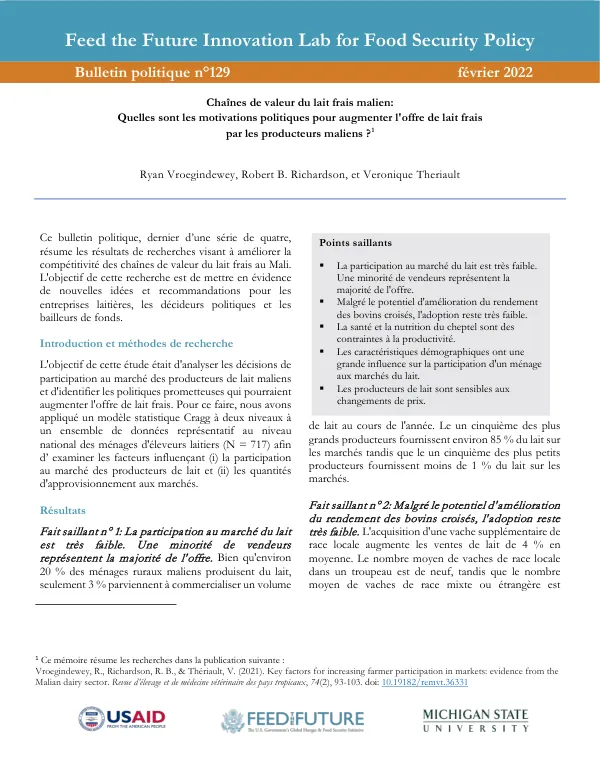
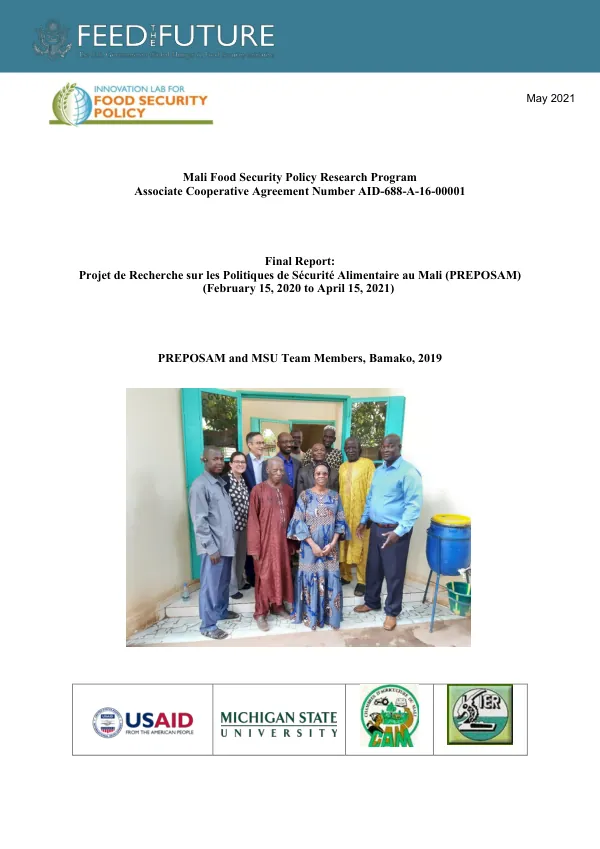
Final Report: Projet de Recherche sur les Politiques de Sécurité Alimentaire au Mali (PREPOSAM)
Sign inMICHIGAN STATE UNIVERSITY FOUNDATION
Final Report: Projet de Recherche sur les Politiques de Sécurité Alimentaire au Mali (PREPOSAM)
The PRePoSAM project, a collaborative research initiative between Michigan State University (MSU) faculty and Malian scientists, aimed to promote an improved agricultural policy environment in Mali.
2020 · 20 pages
Sign in to readA free account is required to download.
Abstract
The project's objectives centered on three major sets of activities: collaborative research, policy outreach, and capacity building. These efforts focused on MSU faculty working with Malian scientists at several local and regional institutions, including the Institut d'Economie Rurale (IER), Institut Polytechnique Rural de Formation et de Recherche Appliquée (IPR/IFRA), and Cellule de Planification et des Statistiques du Secteur Développement Rural (CPS/SDR). During the fifth and final year of PRePoSAM, the project emphasized improving the agricultural policy environment in Mali, with a focus on input policies. Substantively, the research on the impacts of the fertilizer subsidy program was finalized, and additional survey activities and analysis were undertaken to advance research on pesticide quality. The project also began to expand its work on the agri-food system transformation by examining the consumption demand structure of Malian households and conducted additional research on the impacts of COVID-19. As of April 2021, PRePoSAM collaborators completed 11 policy research and best practice papers, submitted 5 articles for publication in peer-reviewed journals, and supervised 5 IPR student theses and 2 graduate students. The project's research outputs included a synthesis of the impacts of the fertilizer subsidy program, a qualitative risk assessment of pesticide use, and an elasticity of demand of food items. Additionally, the project synthesized dietary changes and seed policy recommendations. The PRePoSAM project considered agricultural input policy reform both important and feasible. Based on the stream of policy research, outreach, and dialogue conducted by MSU faculty and Malian scientists over the five years of the project, the team believed that key stakeholders in government and in the private sector were aware of shortcomings in the implementation of these policies and were open to changes. However, the combination of political transition and COVID-19 severely limited the project's capacity to engage in policy outreach during the final year. The project's research findings were expected to help shape policy reflections under way in the agricultural input policy area while contributing to greater awareness about the role of gender and nutrition in agricultural and rural development. The PRePoSAM project's achievements during 2020/21 demonstrated the potential for collaborative research and policy outreach to improve the agricultural policy environment in Mali and promote sustainable agricultural productivity gains and improved food security for the country's citizens.
Related documents