USAID DEC
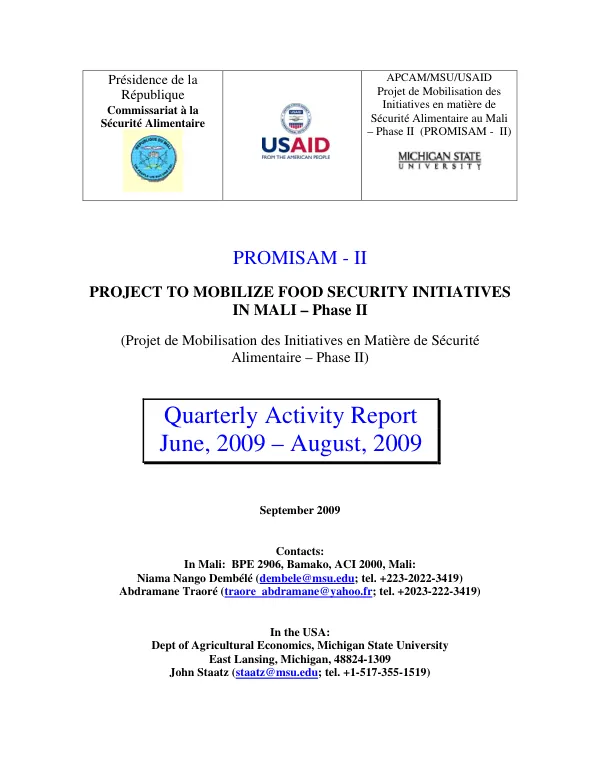
Quarterly Activity Report: Project to Mobilize Food Security Initiatives in Mali – Phase II (PROMISAM - II)
Sign inINTERNATIONAL PEACE CORPS
Quarterly Activity Report: Project to Mobilize Food Security Initiatives in Mali – Phase II (PROMISAM - II)
The agricultural development initiative in Mali, known as PROMISAM II, is a project to mobilize food security initiatives in the country.
2009 · 14 pages
Sign in to readA free account is required to download.
Abstract
Funded by USAID, the project aims to strengthen the capacity of the Malian government to develop analytical and market-based food security responses. The project has four objectives: (i) enhance and develop the technical and analytical skills of the Malian food security commission (CSA) and related support agencies; (ii) assist Mali in implementing food security plans country-wide through the developing and testing of methods for monitoring plan implementation; (iii) help IPR/IFRA de Katibougou to develop an academic and practical curriculum in support of Malian educated analysts in a range of components to ensure continuing food security; and (iv) provide technical support to Mali's national team developing Mali's NEPAD/CAADP report and national compact. The project is implemented by Michigan State University (MSU) in partnership with the Malian Food Security Commission (CSA) and the Permanent Assembly of the Malian Chambers of Agriculture (APCAM). Other key collaborators include the Institut Polytechnique Rural de Formation et de Recherche Appliquée (IPR/IFRA) de Katibougou and the Institut d'Economie Rurale (IER). The project represents part of a larger portfolio of applied research, outreach, and capacity-strengthening activities on food security implemented by MSU in Mali with funding from various sources, including USAID/Mali, USAID/WA, the Syngenta Foundation for Sustainable Agriculture, the William and Flora Hewlett Foundation, the Bill and Melinda Gates Foundation, and ECOWAS. During the quarter of June-August 2009, significant progress was made in achieving all four project objectives. The project carried out various activities, including preparing briefing notes for the U.S. Ambassador to Mali, participating in a USAID/EGAT-sponsored study of the rice value chain in Mali, meeting with consultants to discuss food security issues in Mali, and helping design a new approach for the Peace Corps Master's in International Development (MID) Program. The project also began the development of a database system to track and report project outputs and outputs from MSU's non-USAID-funded food security activities in Mali. In terms of objective 1, enhancing the technical and analytical skills of the CSA and related support agencies, the project carried out several activities during the quarter. These included organizing a retreat of Malian experts to develop proposals for a new national cereals marketing strategy, providing analytic support to the CSA, and launching or expanding two major studies on cereals marketing in Mali. The first round of a major study of farmers' grain production and marketing strategies in three regions of the country was undertaken in collaboration with IER. This study aims at updating information from the 1980s on farmers' marketing and household food security strategies. The study will involve four rounds of surveys of 450 households through June 2010 and began in May in the Koutiala zone and was launched in the other two zones in June.
Related documents